
- NEWS
- the EDIT
- COMMENTARY
- BUSINESS
- LIFE
- SHOW
- ACTION
- GLOBAL GOALS
- SNAPS
- DYARYO TIRADA
- MORE

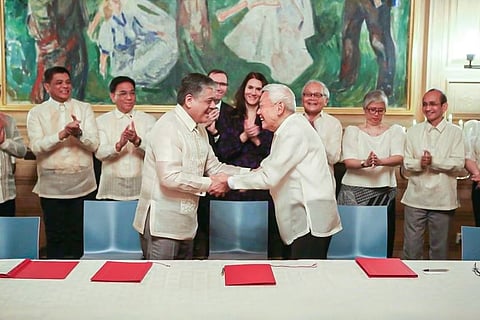
The Philippine government and the communist rebels have decided to resume peace talks following a six-year break to bring to an end the long-standing armed conflict.
In a press conference, Peace Process Adviser Carlito Galvez said the agreement between the two parties acknowledged their recognition of the fundamental issues underlying the armed conflict.
"The parties agree to a principled and peaceful resolution of the armed conflict," said Galvez, referring to the Oslo Joint Communique agreement.
"Resolving the roots of the armed conflict and ending the armed struggle shall pave the way for the transformation of the CPP-NPA-NDFP," he noted.
Galvez said the discussions would also involve the potential removal of the Communist Party of the Philippines and its associated groups, like the New People's Army, from the government's list of designated terror organizations.
He said the rebels are expected to end their armed struggle and transition into a political entity if the negotiations succeed.
"We will start anew, right from the very start," Galvez said.
He added he is optimistic about the relationship between the government and the National Democratic Front of the Philippines under the Marcos administration.
Despite this, Armed Forces of the Philippines Chief of Staff General Romeo Brawner Jr. clarified that no ceasefire has been declared, indicating that operations against the rebels would persist.
Brawner, however, pointed out that a peace agreement would enable the armed forces to redirect its attention from domestic conflict toward external and territorial defense.
"If this conflict finally ends, your AFP will be able to shift its focus to external or territorial defense. Our resources and efforts will be poured into defending our territory," he said.
The enduring armed conflict, which began in 1969, emerged from the global communist movement and took root in the stark economic disparity between the rich and poor in the Philippines.
During its zenith in the 1980s, the group comprised approximately 26,000 combatants, a figure that the military claims has since diminished to just a few thousand.
Since 1986, consecutive Philippine governments have engaged in peace negotiations with the communists through their political faction based in the Netherlands, known as the NDF.
The election of former President Rodrigo Duterte in 2016, who identified as a socialist, initially sparked hope for renewed peace talks.
The most recent formal discussions occurred in 2017 but were abruptly ended by Duterte, whose attempts to restart negotiations were unsuccessful.
Ferdinand Marcos Jr. assumed the presidency from Duterte in mid-2022.
Marcos last week issued an order granting amnesty to various rebel factions, including individuals formerly associated with the communist movement.
With AFP
