
- NEWS
- the EDIT
- COMMENTARY
- BUSINESS
- LIFE
- SHOW
- ACTION
- GLOBAL GOALS
- SNAPS
- DYARYO TIRADA
- MORE
The 2016 Permanent Court of Arbitration award has proven to have a more significant value than favoring the Philippine position in the West Philippine Sea dispute as international law experts said it plugged the legal loopholes on the freedom of navigation.
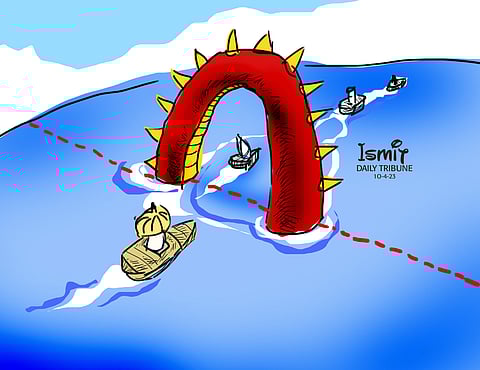
China insists on its historical claim to the West Philippine Sea, or WPS, but it never articulated the legal status of the sea areas within the "nine-dash line," which lie beyond its territorial sea and exclusive economic zone, or EEZ, under the United Nations Convention on the Law of the Sea.
"However, by laying 'historic' claim to all the WPS features (islands, rocks, and reefs) and referring to all these as islands entitled to EEZ and Legal Continental Shelf status, it has implicitly claimed sovereign jurisdiction over the entire sea area enclosed within the nine-dash line," National Maritime Foundation of New Delhi Executive Director Gurpreet Khurana said.
"Based on such assumed sovereign rights — though disputed by other claimant states — China has been curtailing freedom of navigation in these areas, particularly for warships," Khurana added.
He recalled that in the days leading to the international tribunal's verdict on the China-Philippines arbitration, Beijing declared a "no sail zone" in the area of dispute during a major naval exercise from 4 to 11 July 2016.
Initially, it was solely the United States that had been actively conducting naval operations to protect the international sea lanes, but Beijing's increasing aggressiveness raised the threat level in the region.
The WPS is one of the world's most important shipping lanes. Ships carrying goods between markets in Asia, Europe, Africa, and the Americas transit through it. An estimated $5.3 trillion in trade passes through the sea annually.
One country controlling the sea lane may require ships to circumnavigate it, which would involve considerable expense and delays in delivering goods.
Thus, most nations have a direct stake in ensuring that freedom of navigation is respected in the WPS.
Geopolitical analysts said the actions of China, mainly the setting up of infrastructure in the disputed maritime zone, have been the source of the escalation of threats of direct conflict.
Beijing has accused the Philippines and the United States of scaling up the stakes in the disputed waters through provocative actions like the recent expansion of the Enhanced Defense Cooperation Agreement or EDCA.
China, nonetheless, has left out the need to keep the lanes open to all nations, which is the paramount issue.
The US has said it does not take a position on territorial disputes over features in the WPS. Its involvement concerns the illegal claims to the waters surrounding sea features and the illegal restrictions on navigation.
Several states in the region have made excessive maritime claims that illegally limit the freedom of navigation. Washington said it conducts freedom of navigation operations in the WPS to protest these claims.
China has accused the Philippines of being complicit with the US in the latter's actions in the WPS, and when it comes down to the issues involved, the accusation could only be true.
The Philippines joins other countries in ensuring that the sea passage remains open to all nations, and a single country's control of the international waters should never be allowed.
Despite Beijing's oft-repeated claim that it adheres to UNCLOS, its actions in the WPS are inconsistent with the law. Just recently, it expanded its historic claim to a 10-dash line.
As a responsible member of the international community, nations expect China to adhere to the international tribunal ruling.
China respecting the arbitration award would not only contribute to peace and prosperity, it would be in the long-term interest of all, including that of the superpower.
