 Daily Tribune
By not including money for Ukraine’s defense in the 2024 spending bill, the US has lost the chance to demonstrate its dedication to the defense of democracy.
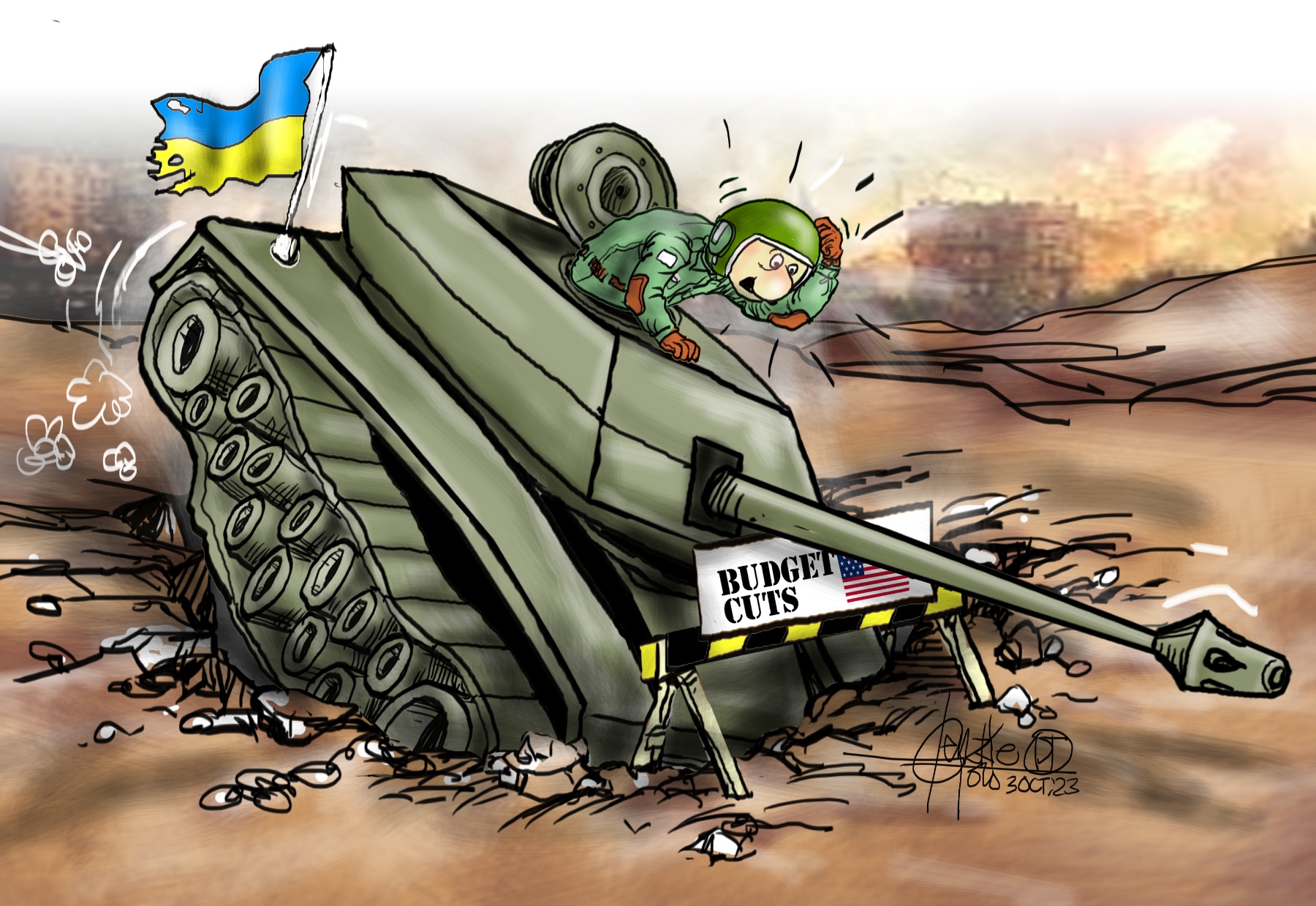
By passing a financing bill at the last minute, the United States Congress avoided a federal government shutdown this week. However, the Biden administration's top priorities, including defense financing for Ukraine, were left out of the final package.
For countries like the Philippines, which has cozied up anew to Uncle Sam, this is cause for concern because America has practically left Ukraine high and dry without the full backing it needs to defend itself against Russia.
Okay, so Biden said they "will not walk out of Ukraine." Still, without funding, that's just lip service.
Having perfected the art of emotional suasion at one end of the pole and brinkmanship on the other, we would not be surprised if Ukraine President Volodymyr Zelensky would tell Biden: "Show us the money."
Sacrificing Ukraine casts doubt on America's dependability as a coalition partner and ally, even as it stakes a claim to a long tradition of backing democracies in their fight for independence. The Philippines should take note.
In the US, it's clear that whatever the executive branch pledges, the US Congress can always override or, as made apparent again now, starve of funding. That's the power of holding the purse string that could certainly affect America the mighty's projection of power.
From propping up South Vietnam with billions of dollars in war materiel only to leave Saigon in a huff — with choppers flying off the rooftop of the US Embassy in a hasty, humiliating retreat in 1975 — to giving substantial aid to Israel and Middle Eastern countries, the US has not stopped its posturing as the "policeman of the world."
As in Vietnam and Afghanistan, where in the latter it also abruptly pulled out its forces, thereby allowing the Taliban to retake the country in 2021, the US, for all its fire-and-brimstone statements at the start of the Ukraine-Russia war, may have turned its back on its legal and moral responsibility to aid Kyiv.
As an adversarial state under madman Vladimir Putin, Russia has been destabilizing international norms, and Ukraine, by fighting back, has been sending the strong message that autocratic governments cannot make the globe their playground.
By not including money for Ukraine's defense in the 2024 spending bill, the US has lost the chance to demonstrate its dedication to the defense of democracy.
But such are the vagaries of the budgeting process in the United States and, of course, the Philippines, with the latter's form of government and jurisprudence loosely patterned after America's.
In the US, government shutdowns have happened before and will happen again when the legislature and the executive branches are unable to reach an agreement on priorities and lawmakers do not enact a budget in a timely manner.
The budget can also be wielded as a political baton with which to make the executive branch more malleable. An example would be the 2013 shutdown in an attempt to defund the Affordable Care Act.
Frequent disagreements on spending priorities between the two parties in the US Congress have led to stalemates, with neither side willing to pass the budget unless their demands were met. Budget delays had caused negative effects on the economy and public services.
Some may argue that past shutdowns of the US federal government would show the Philippines has a more mature budgetary system in place, as a failure to pass the budget for a new fiscal year only results in a reenacted budget.
But the problems associated with a reenacted budget abound. There's the delayed implementation of new programs and projects. This, as a reenacted budget only allows for the funding of existing programs and projects.
A reenacted budget also limits government flexibility to respond to changing needs. For example, if the economy experiences a downturn, the government may need to increase spending on social programs or infrastructure projects. However, this is not possible under a reenacted budget.
But probably the biggest risk associated with a reenacted budget would be corruption, as it can give the executive branch more leeway or elbow room to fund projects while reallocating "savings" from projects that had been funded previously.
In the shadow of budgetary bludgeoning and political brinkmanship, the recent passage of the US funding bill left Ukraine's defense hanging by a thread, a stark reminder of the capriciousness of budgeting processes in both the United States and the Philippines, where legislative complexities often take precedence over strategic imperatives.
The budget's power to shape policy and dictate priorities, as seen in the Philippines with past reenacted budgets, illustrates the pitfalls of wielding fiscal levers as political weapons. In both nations, the budgeting process, while designed to reflect the will of the people, is susceptible to political posturing, causing disruptions and imperiling the very ideals of democracy it should be upholding.


