
- NEWS
- the EDIT
- COMMENTARY
- BUSINESS
- LIFE
- SHOW
- ACTION
- GLOBAL GOALS
- SNAPS
- DYARYO TIRADA
- MORE
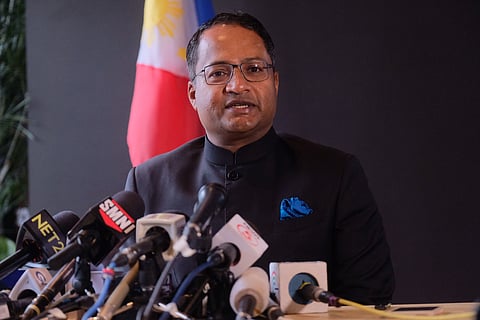
It is only natural for countries affected by the newly published map of China to react over the inclusion of their sovereign territories in Beijing's '10-dash' map, Indian Ambassador to the Philippines Shambhu Kumaran said Friday.
"Broadly speaking, I would say that countries should be sensitive to each other's concerns and when some actions are taken, it is natural that those affected will express their concern," Kumaran told reporters in a press briefing organized by the Indian Embassy in the Philippines.
He issued the remarks after the Chinese Ministry of Foreign Affairs defended its newly published map and called on countries affected by their new map to "stay objective and calm, and refrain from over-interpreting the issue."
The 2023 version of China's Standard Map issued by the Ministry of Natural Resources of the People's Republic of China on 28 August covers the exclusive economic zones of Southeast Asian claimant states in the South China Sea, prompting the Philippines, Malaysia and Vietnam to release strongly-worded statements against it.
India also lodged a protest over the inclusion of the Indian state of Arunachal Pradesh and the Aksai Chin plateau as official Chinese territory.
For Kumaran, countries that have rejected the new map of China are just being "forthright in expressing their concerns."
"That does not in some way imply that those countries are being not so calm. I think they are being forthright in expressing their concerns," he said.
"I think countries like India and the Philippines have been quite forthright when our interests are affected, I think we could continue to be forthright," he added.
According to the Indian diplomat, India and Bangladesh were once in the position of China and the Philippines. However, India chose to adhere to international law.
"You have to adhere to international law whether it goes to your favor or not. In the case of the award between India and Bangladesh, it was favorable to Bangladesh, but that did not mean India would walk away from it," he said.
China claims the vast South China Sea, including the West Philippine Sea.
On 12 July 2016, the Philippines won its arbitral case against China in the Permanent Court of Arbitration — a landmark decision that China continues to reject.
Kumaran also said that India is in solidarity with the Philippines in the recent actions of China in the South China Sea.
"I would express my solidarity with the sentiment in the Philippines with regard to such efforts at what I would call 'cartographic expansionism,'" he said.
"I think it's important to state our positions and our views. I think both India and the Philippines have done that," he added.
