
DILG, DepEd sign IRR for expanded early childhood care system

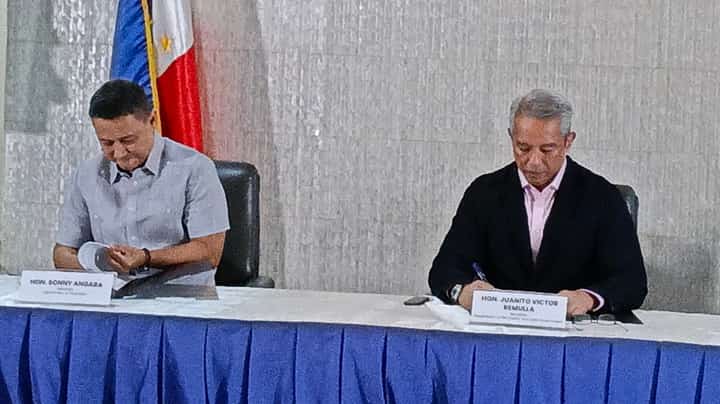
The DILG and DepEd have signed the IRR of RA 12199, expanding the Early Childhood Care and Development System to provide integrated health, nutrition, and quality early learning for Filipino children from birth to age 8, with LGUs, CDCs, and a whole-of-government approach strengthening foundational education nationwide.
Interior and Local Government Secretary Jonvic Remulla and Education Secretary Sonny Angara on Wednesday led the signing of the Implementing Rules and Regulations (IRR) of Republic Act No. 12199, or the Early Childhood Care and Development (ECCD) System Act, signaling the nationwide implementation of a strengthened and integrated early childhood care system that expands access to health, nutrition, and quality early learning for children from birth to 8 years old.
The ceremonial signing, held at the Quezon City Reception House, operationalizes the government's whole-of-government strategy to ensure continuity in early childhood education through basic education while leveraging local government units (LGUs) in the delivery of community-based ECCD services.
"Kung seryoso tayong baguhin ang kinabukasan ng Pilipinas, kailangan nating magsimula sa ating mga pinakabatang kababayan. Dito nagsisimula ang tunay na nation-building," Angara said.
Citing UNESCO data, Angara, who co-authored the landmark legislation during his tenure in the Senate, said investments in early childhood education can yield returns of up to 13 percent through improved health outcomes and economic growth.
He emphasized that supporting children during their earliest years remains one of the most effective strategies for securing the country's long-term future.
The Department of Education (DepEd) said strengthening foundational learning begins long before a child enters formal schooling. By promoting early literacy, numeracy, and holistic child development, the ECCD System Act lays the foundation for improved learning outcomes throughout basic education.
Earlier, Angara led the Philippine delegation to the 14th ASEAN Education Ministers Meeting (ASED) in Singapore, where ASEAN education ministers endorsed the Philippine-led ASEAN Declaration on Foundational Learning for approval at the 49th ASEAN Summit in November 2026.
Following its adoption, the Philippines will lead the development and implementation of the declaration's roadmap, reinforcing its commitment to advancing foundational learning across Southeast Asia.
The signing ceremony brought together key officials from the executive and legislative branches, including the principal sponsors of Republic Act No. 12199 and members of the Second Congressional Commission on Education (EDCOM 2).
Also present were member agencies of the ECCD Council, including the Department of Social Welfare and Development (DSWD), Department of Health (DOH), Commission on Higher Education (CHED), Technical Education and Skills Development Authority (TESDA), Department of Agriculture (DA), and the National Nutrition Council (NNC).
The rollout comes alongside efforts to expand access to quality early learning through the establishment of Child Development Centers (CDCs) in low-income LGUs.
Backed by a ₱1-billion allocation under the Local Government Support Fund–Financial Assistance to Local Government Units (LGSF-FALGU), ₱741 million has already been released to 247 beneficiary barangays.
As of July 2026, 14 CDCs have been completed, 113 are under construction, and 106 are undergoing procurement.
Beyond infrastructure, the IRR provides clear guidelines for LGUs to institutionalize local ECCD offices, professionalize Child Development Workers through the creation of plantilla positions, and implement localized ECCD roadmaps aligned with the national strategy.
"Sa tulong ng IRR na ito, naniniwala akong lalo pang titibay ang ating mga programa at mas mapapalawak ang serbisyong maihahatid natin sa bawat batang Pilipino," Angara said.