
AboitizPower taps Korean firm for nuclear study
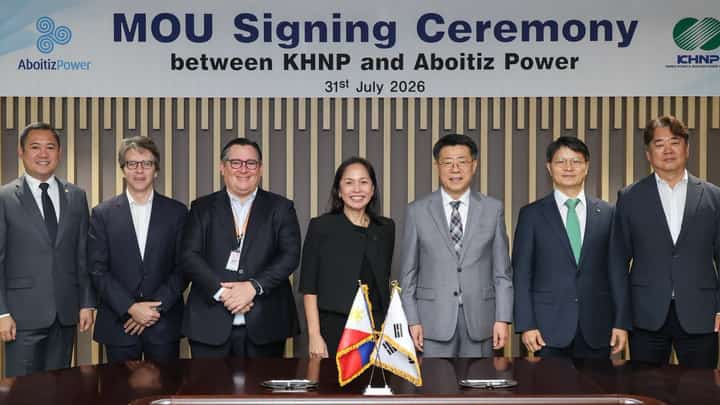
Aboitiz Power Corp. (AboitizPower) has partnered with South Korea's Korea Hydro & Nuclear Power Co., Ltd. (KHNP) to assess whether nuclear energy can become part of the country’s future power mix as the government pushes to bring atomic energy online over the next decade.
The listed power firm said Wednesday it signed a memorandum of understanding (MOU) with KHNP covering joint studies, technical knowledge exchange, and capacity-building initiatives to evaluate the potential application of nuclear technologies in the country's power sector.
"Building on KHNP's extensive experience and technical expertise gained through construction and operation of nuclear power plants both in Korea and overseas, we look forward to working closely with AboitizPower to support the Philippines' energy transition," said KHNP Senior Executive Vice President for the Business Development and Management Division Il-kyung Choi.
The agreement was signed by Choi and AboitizPower Chief Corporate Services Officer Carlos Ramon Aboitiz in the presence of AboitizPower President and CEO Danel Aboitiz, Department of Energy Secretary Sharon Garin, and National Power Corp. President and CEO Jericho Jonas Nograles.
For AboitizPower, the partnership will help build technical expertise on nuclear energy while assessing whether the technology can help strengthen the country's long-term energy security.
"This MOU marks a meaningful step in AboitizPower's efforts to understand nuclear energy's potential contribution to the Philippines' energy security and reliable baseload capacity," Carlos Ramon Aboitiz said.
"Nuclear energy is complex and highly regulated, and any future role for it must be grounded in rigorous technical assessment and strong regulatory oversight," he added. "We see significant value in learning from KHNP's decades of experience, and we look forward to working alongside the Department of Energy to responsibly assess nuclear energy's role in the country's energy future."
The partnership aligns with the government's push to revive the country's nuclear energy program under the Philippine Energy Plan, which targets 1,200 megawatts (MW) of nuclear capacity by 2032, expanding to 2,400 MW by 2035 and 4,800 MW by 2050.