
Batanes amid Beijing’s lawfare
Diplomacy without leverage is theater, but repeated, coordinated legal pressure is how smaller states have always fought larger ones without firing a shot.

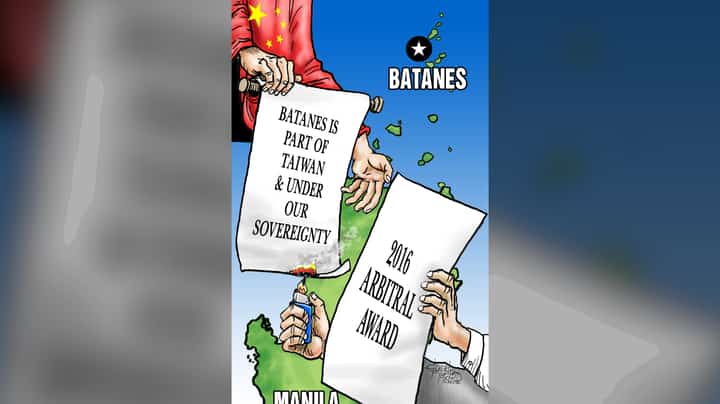
A symposium hosted by Jinan University in Guangzhou in late June has placed Batanes at the center of a new argument over history, geography and sovereignty after scholars at the event claimed the island belonged to Taiwan and, on that basis, fell under Chinese sovereignty.
This claim over Batanes, while not formally adopted by Beijing, must be rejected outright.
Batanes should be taken seriously precisely because it looks so easy to dismiss. A dozen academics at a Guangzhou symposium, none of them government officials, arguing that an inhabited Philippine province of fewer than 20,000 people is actually a “natural geographical extension” of Taiwan — this reads like the kind of claim that answers itself.
It doesn’t have the weight of a formal note verbale or a PLA deployment. But that is exactly how Beijing’s lawfare works: It does not need an official flag-planting when a symposium, a state-affiliated news write-up and compliant silence from the Foreign Ministry can do the job.
Analysts describe the claim as the latest example of Beijing’s “lawfare” campaign to bolster its maritime assertions; and the scholars’ assertion, while not formally endorsed by Beijing, set a potentially worrisome precedent for the Philippines nonetheless.
The timing gives the game away. The claim surfaced days before the Philippines marked the 10th anniversary of the 2016 arbitral award it won against China and right after Manila and Tokyo announced maritime boundary talks in waters east of Taiwan.
Put bluntly, China cannot contest the EEZ delimitation between two sovereign states on legal grounds, so it manufactures a geography instead, one convenient enough to insert Chinese-claimed territory between them.
Defense Secretary Gilberto Teodoro called it “baseless” and “ludicrous,” and Manila’s Foreign Affairs spokesperson Analyn Ratonel said the country’s sovereignty over Batanes is “settled and not up for debate.”
Both are right. But contempt is not a strategy, and Beijing’s own playbook — normalize a narrative first, enforce it later — means the government cannot afford to only scoff.
What Manila should do is to treat this the way National Security Adviser Eduardo Oban already has: Acknowledge that the claim has no merit while refusing to ignore how repetition manufactures ambiguity where none should exist.
This means documenting and publicizing the claim’s chronology, refuting it point by point through the Department of Foreign Affairs and the National Historical Commission rather than letting it circulate unanswered in Chinese state media, and coordinating with Japan to proceed with the EEZ negotiations rather than pausing them, as that would only reward the pressure.
It also means treating China Coast Guard patrols near the Bashi Channel, which have unsettled planners in Manila, as the operational half of what is otherwise a rhetorical exercise — and briefing allies accordingly.
This is where the joint statement matters. Thirteen Philippine allies — the United States, Japan, Australia, Canada and nine European states — declared on the tenth anniversary of the 2016 international arbitral award that it was “final, legally binding and definitive,” and the European Union separately called for its full implementation.
None of this compels Chinese compliance; Beijing has spent a decade calling the ruling a “poisoned legacy” and will keep doing so.
But the value of the joint statement was never enforcement. It is attrition. Every reaffirmation narrows the diplomatic space in which China can plausibly claim its position is anything but isolated, and it gives the Philippines a standing coalition to invoke the next time Beijing tries exactly this kind of maneuver.
Diplomacy without leverage is theater, but repeated, coordinated legal pressure is how smaller states have always fought larger ones without firing a shot.
Malacañang’s instinct to pursue our rights through diplomacy rather than confrontation is correct, provided diplomacy stays firm, specific and unembarrassed about naming the aggressor.
Silence is the one response Batanes cannot survive.