
Rule of law, live!
If this trial encourages even a few young people to study the law and dedicate themselves to public service, then it will have produced something far more enduring than headlines.

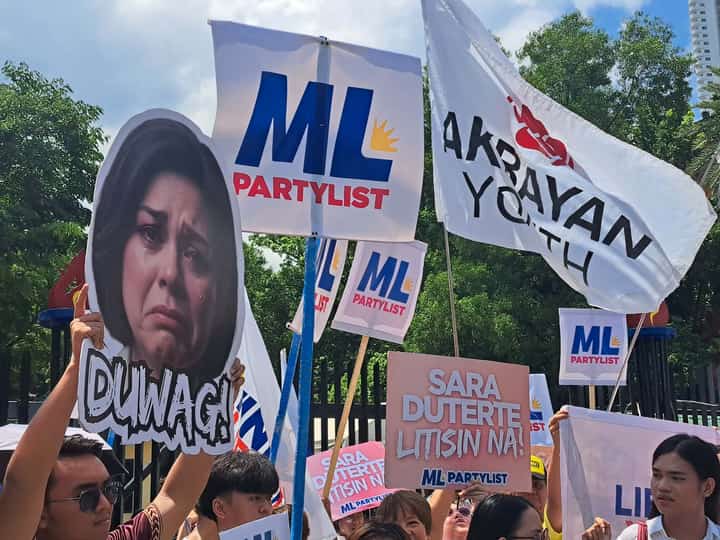
Members of Tindig Pilipinas carry symbolic copies of the Articles of Impeachment against Vice President Sara Duterte during the group's "Lakbay Pananagutan" relay on Sunday, a day before the Senate convenes as an impeachment court.
PHOTO BY: Lisa Marie Apacible
The past week has offered a rare reminder that democracy is not only exercised during elections, but in fact is tested on a daily basis in the institutions designed to hold public officials accountable.
Like millions of Filipinos, I was glued to the television, watching the live impeachment trial of Vice President Sara Duterte unfold. But unlike many viewers, I watched it not solely as a lawyer and public servant, but also as a daughter.
Years ago, my own mother faced impeachment proceedings as the Ombudsman. Although the case did not proceed, I remember the terrible weight the impeachment case had carried, not only for her but also for us, her family, which quietly endured the scrutiny.
That experience taught me that behind every legal process are real people whose lives are profoundly affected and many times altered. Perhaps that is why the proceedings have resonated so deeply with me.
What has struck me most was how the proceedings seemed to have transformed ordinary Filipinos into students of the law.
During the second day of the proceedings, the defense repeatedly objected while the prosecution conducted its direct examination of a witness. Suddenly, legal concepts that usually belong only in courtrooms found their way into dining tables, offices, and social media timelines.
People asked: What is a leading question? When is an objection proper? Why was one objection sustained while another overruled?
For many Filipinos, this was their first real glimpse into the discipline, strategy, fascination, and safeguards that define legal advocacy. More importantly, it reminded us that courtroom procedure is not mere technicality. It is to protect fairness, ensure due process, and preserve the integrity of the proceedings.
In many ways, the hearings have become the country’s largest classroom on constitutional law.
I cannot help but hope that among the millions watching are young Filipinos inspired to pursue the legal profession. If this trial encourages even a few young people to study the law and dedicate themselves to public service, then it will have produced something far more enduring than headlines.
But beyond the legal exchanges lies a principle greater than any individual or administration.
Impeachment was never intended to satisfy public outrage, nor to shield those in power. It exists to ensure that accountability itself is exercised within the bounds of the Constitution and the rule of law.
The prosecution deserves full opportunity to present its evidence. The defense deserves every guarantee of due process. Neither should be compromised. The legitimacy of any verdict will ultimately rest not only on its outcome, but on the fairness and credibility of the process that produced it.
Whatever history ultimately records about this impeachment trial, I hope it also remembers that for one remarkable week, an entire nation paused to watch democracy at work.
Millions of Filipinos did not simply witness a political proceeding. They witnessed constitutional principles being tested, legal arguments being examined, and the rule of law unfolding live and in real time.
In the process, we hope many of us realize that the strength of a democracy lies not only in the leaders it elects, but in the institutions that hold them accountable, and in a citizenry willing to understand, question, and participate in that process.