
Ex-law dean: Senate impeachment court cannot compel Jinggoy, Marcoleta in Sara's trial due to separation of powers
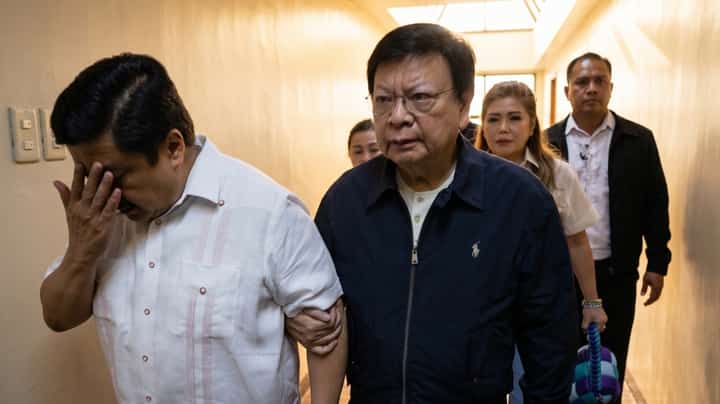
The Senate impeachment court cannot compel the attendance of Senators Jinggoy Estrada and Rodante Marcoleta, both detained on plunder charges, at the ongoing trial of Vice President Sara Duterte, as insisting on doing so could breach the separation of powers between the branches of government, a former law dean warned Tuesday.
Lawyer Mel Sta. Maria, the former dean of the Far Eastern University Institute of Law, made the statement in response to Senator Alan Cayetano’s recommendation to ask the Sandiganbayan to allow Estrada and Marcoleta to perform their duties as senator-judges, given that they could eventually be released on bail or have their cases dismissed.
Sta. Maria argued that since the lawmakers are incarcerated, they are stripped of their liberty and “constrained” by legal limitations.
He pointed to existing Supreme Court jurisprudence that limits the legislative duties of detained lawmakers, as evidenced by prior rulings involving former senators Sonny Trillanes IV and Leila de Lima.
“The spirit of the law is, if you’re already in jail, you do not have the same rights as any other people. You are limited by the law,” he said in ANC’s Headstart.
Assuming the Sandiganbayan would be lenient and permit them to attend the trial in person under police escort, they are restricted from exercising their legislative duties or functioning as senator-judges, including participating in voting, according to Sta. Maria.
This restriction, he emphasized, shall be strictly enforced even if the Senate impeachment court passes a resolution supported by a majority of the senators.
Estrada has been detained since 1 June, while Marcoleta was arrested hours before the impeachment trial began on Monday.
Due to a 90-day preventive suspension imposed by the anti-graft court, Estrada was barred from performing his duties pending the investigation.
Cayetano, however, argued that the impeachment court is sui generis, or a class of its own, separate from the Senate as a legislative body.
As a result, he pointed out that senators should be permitted to fulfil their mandate as judges in an impeachment trial, as their absence would effectively amount to an acquittal vote, which would undermine the principles of a “fair trial.”
On the other hand, Sta. Maria contended that the Senate, though sitting as an impeachment court, is not a judiciary; therefore, it has “no power” to override judicial detention orders.
If it insists on that, he warned that the separation of powers between the legislature and the judiciary will be breached.
“They are not empowered to do so, and they cannot intrude into the exclusive domain of the courts,” he stressed.
Although Marcoleta has not been subjected to preventive suspension, Sta. Maria averred that this does not constitute assurance that the Senate impeachment court could compel his participation, because only the Sandiganbayan holds the discretion to grant such permission.
According to Sta. Maria, the courts, in this case, the Sandiganbayan, only have the authority over the detained senators.
Therefore, the decision whether to allow Estrada and Marcoleta to participate in the impeachment trial while detained rests exclusively with the Sandiganbayan, and the Senate impeachment court has to “follow the law.”
On the second day of the impeachment trial on Tuesday, Cayetano reiterated that, “If they are not allowed to vote, then that will be counted as a vote for acquittal, and that might be favorable to the defense rather than a part of giving a fair trial.”
Senate impeachment court presiding officer Chiz Escudero explicitly set the conviction threshold at 16 votes, regardless of how many senators are present in the trial.
The figure represents two-thirds of the 24-member Senate as constitutionally mandated.
Escudero stated that parties who disagree with the ruling can bring the issue to the Supreme Court.
Senator Ping Lacson on Tuesday questioned whether Escudero’s statement was merely his legal opinion or an official court ruling, but Escudero confirmed that it was the collective decision of the Senate impeachment court, as no senator-judge objected to the ruling on Monday.
The number of senator-judges is now down from 24 to 21 following the arrests of Estrada and Marcoleta, with Senator Bato dela Rosa still in hiding to evade an International Criminal Court warrant.