
Baguio rainwater project delayed amid water woes

BAGUIO CITY — As residents and visitors of Baguio City continue to face water shortages, a project expected to help ease the problem will have to wait longer before it can be completed.
The construction of the Buyog rainwater harvesting facility will undergo another round of public bidding following the termination of its original contract due to severe project delays and negative slippage. Located within the Buyog watershed, which covers Barangays Lower Quirino Hill and Pinget, the project was separated from its original contractor on April 15, 2026.
The first phase of the development has a ₱50-million budget sourced from the national government through the Local Government Support Fund (LGSF).
The Baguio City Engineering Office (CEO) confirmed that its Technical Working Group (TWG) is conducting a pre-evaluation of the remaining work. A pre-bid conference for the unfinished portions of the project was held on June 11, 2026, while the opening of bids from interested contractors took place on June 25, 2026.
Local authorities previously said the project encountered significant engineering challenges, citing unstable soil conditions and the difficult terrain within the watershed, which proved more complex than initially assessed.
At present, only 30% of the project has been completed. Despite the construction setbacks and difficult terrain, project monitoring teams from the City Engineering Office and the Baguio Water District (BWD) rated the completed work as satisfactory.
Once fully operational, the facility is designed to store 7,000 cubic meters of rainwater to help address persistent water shortages affecting residents of Pinget and Quirino Hill, particularly during the dry season.
The BWD plans to collect rainwater at the Buyog facility, store it in localized tanks, and treat it to meet the Philippine National Standards for Drinking Water. According to the utility, the project is intended to augment the city's water supply, improve system efficiency, and promote sustainable water resource management in response to rising demand, climate change, and rapid urbanization.
Officials also expect the facility to reduce operating costs during periods of water scarcity while serving as a flood mitigation structure by regulating stormwater runoff during typhoons.
The delays underscore a deeper, long-standing problem within Baguio City's water supply system.
For decades, the city has struggled with chronic water shortages driven by rapid population growth and an aging distribution network that loses a significant portion of its supply through leaks and unmetered connections. The Baguio Water District has also faced difficulties developing productive deep wells as underground aquifers continue to decline because of over-extraction.
The situation becomes more severe during the summer months and peak tourism season, when water rationing becomes routine in high-altitude communities such as Quirino Hill and Pinget.
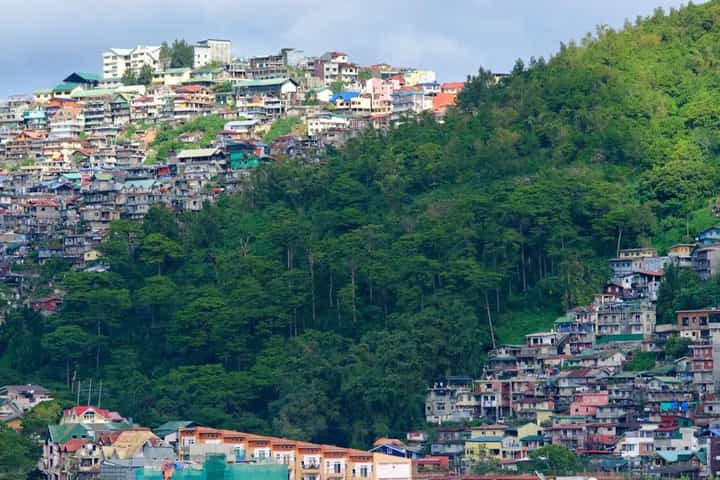
Compounding the problem is the continued degradation of the city's watersheds. The Buyog watershed, one of Baguio's remaining forest reservations, has suffered from decades of illegal structures, encroachment, and deforestation, significantly reducing its natural ability to retain groundwater and recharge aquifers.
As forest cover declines, rainfall increasingly becomes surface runoff instead of infiltrating the ground to replenish groundwater reserves. This environmental degradation prompted the local government to invest in engineering solutions such as the ₱50-million rainwater harvesting facility to capture and store runoff.
However, the termination of the project's original contractor highlights the bureaucratic and implementation challenges that continue to delay critical water infrastructure.
As construction remains unfinished, affected communities continue to rely on costly water deliveries and strict rationing schedules. With groundwater levels declining and urban migration continuing, the slow pace of infrastructure development leaves the city vulnerable to prolonged water shortages, underscoring the gap between municipal sustainability goals and actual project implementation.