
How three RTU students reached space

Three Filipino astrophysics students from Rizal Technological University (RTU) have achieved a milestone few can claim: seeing their scientific experiment conducted aboard the International Space Station (ISS).
Christopher Tumamac, Ryan Andrew Doña and Rose Ann Cezar, all third-year astrophysics students, successfully sent their double gyroscope experiment into space after winning the 2025 Asian Try Zero-G (ATZG) competition organized by the Japan Aerospace Exploration Agency (JAXA).
Their team, Blue Stragglers, emerged as one of only 11 finalists selected from nearly 500 experiment proposals submitted by 1,176 applicants across nine participating countries and regions. Of the 89 entries from the Philippines, theirs was among the few that advanced to the final stage.
Their journey culminated on 24 March 2026, when NASA astronaut Christopher Williams conducted their experiment inside the Kibo module of the ISS.
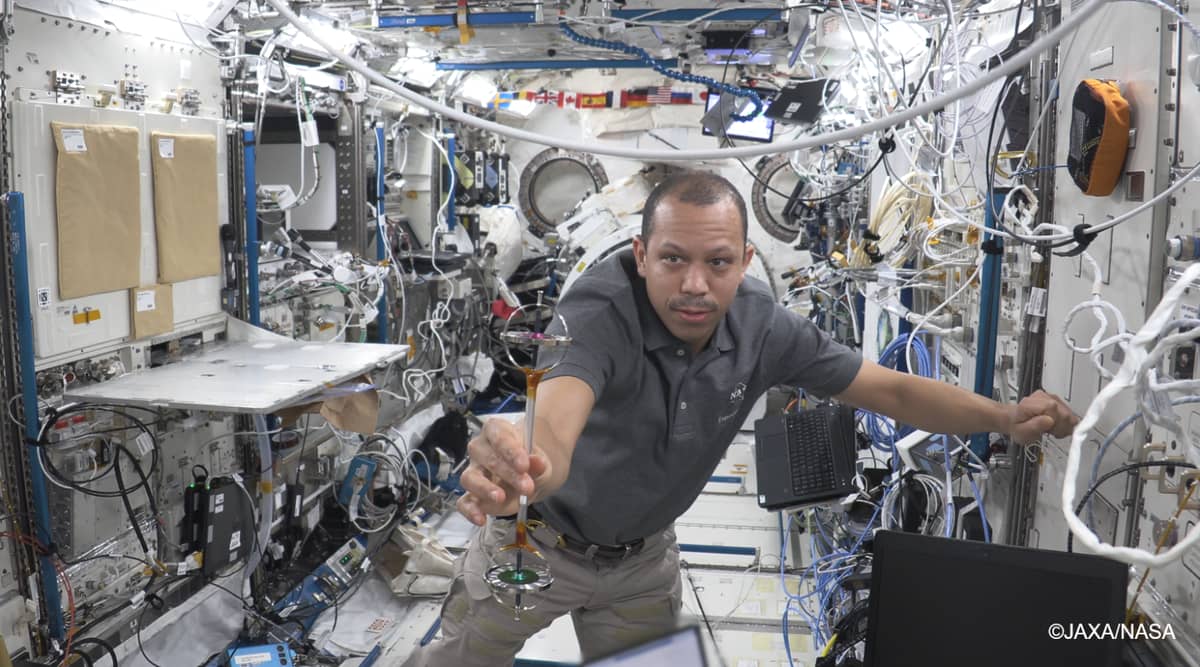
NASA astronaut Christopher Williams performs the Double Gyroscope experiment as part of the Asian Try Zero-G on the International Space Station (ISS). Photo courtesy of JAXA/NASA.
For the students, the accomplishment was both exhilarating and humbling.
“It feels overwhelming because it was a big achievement and a big responsibility,” Cezar told DAILY TRIBUNE.
“It’s not just our name or the name of our university that we carried, but also the name of the Philippines.”
The space mission
The team's experiment centered on a simple but ambitious concept: a stick with two gyroscopes mounted on opposite ends.
What began as a classroom prototype evolved through months of collaboration and refinement under JAXA’s guidance. The final version was tested at Japan’s Tsukuba Space Center before being transported aboard the HTV-X1 cargo spacecraft to the ISS.
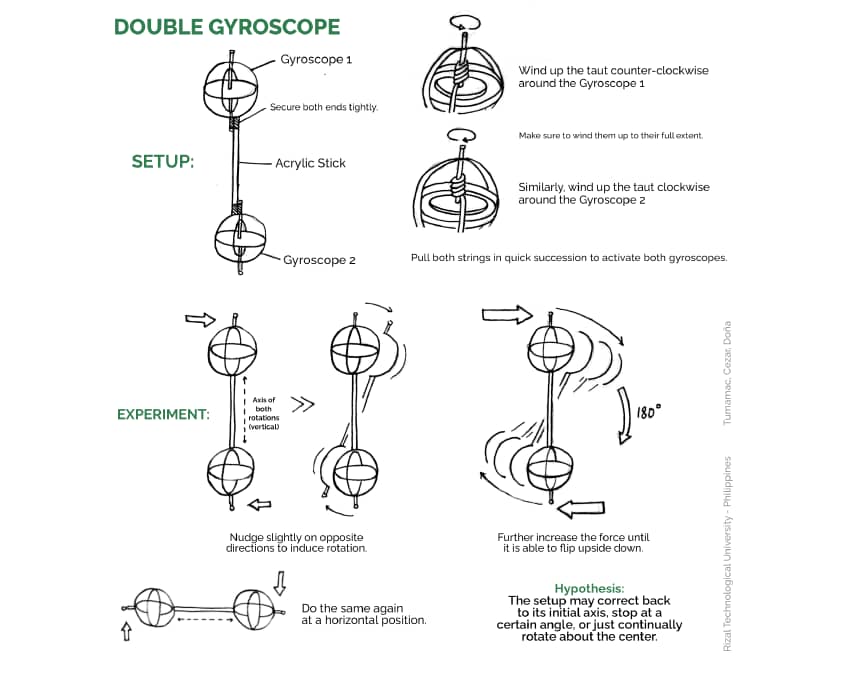
Double Gyroscope proposal/PHILSA
Once in orbit, astronaut Williams carried out the experiment inside Kibo, Japan’s laboratory module on the station.
The researchers initially planned four trials—two for each hypothesis. However, an unexpected mishap altered the procedure.
“While the astronaut was conducting the experiment, he accidentally knotted the strap of one of the gyroscopes,” Doña explained. “Instead of two trials per setup, only two trials were completed on opposite sides.”
Despite the setback, the students considered the mission a success, especially given the opportunity to test their concept in the unique environment of microgravity.
“It felt like a dream,” Doña said, describing the moment their experiment reached space. “It was really a shot in the dark.”
The future of flight
Beyond the achievement itself, the team believes their research could contribute to future spacecraft navigation systems.
Gyroscopes are devices that help maintain orientation and balance. In the students’ design, two gyroscopes spin at either end of a rod. Their hypothesis suggests that when both gyroscopes rotate in the same direction, the system becomes more stable and resistant to disturbances.
Such stability could reduce a spacecraft’s reliance on thrusters, conserving valuable fuel during reorientation maneuvers.
“To orient a spacecraft to a certain position without constantly using fuel is very important,” Doña said. “If you use energy and fuel every time you reorient it, that’s not sustainable because you’ll burn through the fuel very fast.”
The concept builds on technologies already used in satellites, including reaction wheels and control moment gyroscopes, which allow spacecraft to make precise adjustments without firing engines.
“When you're trying to move satellites by very minute degrees, multiple gyroscopes are being used,” Tumamac explained. “That’s where the significance of our experiment comes in.”
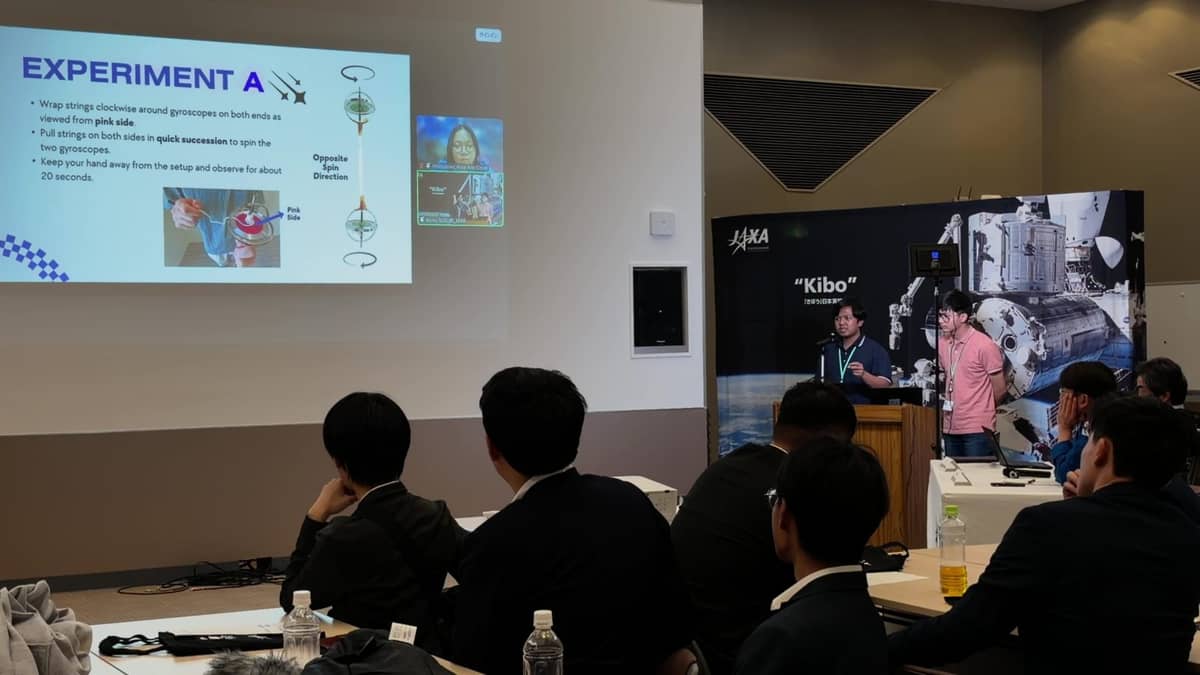
Christopher Tumamac and Ryan Andrew Doña present their experiment proposal at the Tsukuba Space Center, Japan./PHILSA
A sci-fi vision
For the students, the possibilities extend beyond today’s space missions.
They envision future spacecraft that use spinning systems not only for navigation and stability but also to create artificial gravity—an idea often depicted in science-fiction films.
“What you see in movies like The Martian or Interstellar, where the spacecraft rotates and the centrifugal force serves as artificial gravity for astronauts, that’s similar to a gyroscope if you think about it,” Tumamac said.
While their experiment represents only a small step toward such technology, the team believes it offers valuable insights into how spinning systems can help stabilize spacecraft in the future.
“It’s not just about introducing artificial gravity,” he added. “A gyroscope can also help stabilize the entire spacecraft in a single orientation.”
For three Filipino students whose idea began as a classroom project, the experiment’s successful journey to the ISS is already proof that even the most ambitious dreams can reach beyond Earth.