
Philippines lost 1.42M hectares of tree cover in 22 years — study
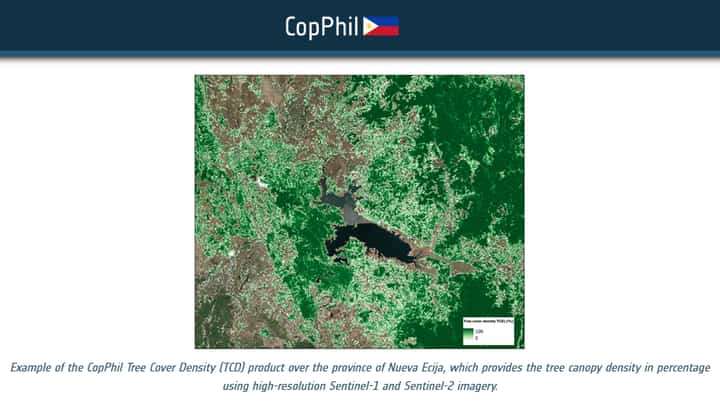
Example of the CoPhil Tree Cover Density (TCD) product over the province of Nueva Ecija, which provides the tree canopy density in percentage using high-resolution Sentinel-1 and Sentinel-2 imagery.
Photo from: CoPHIL
The European Union Copernicus Programme in the Philippines (CoPHIL) reported that about 1.42 million hectares of tree cover were lost in the country over a 22-year period, leaving only 24 percent of the nation’s land area under forest cover.
“Today, only around 24% of the country’s land area remains under forest cover, stressing the urgency of sustained monitoring and conservation efforts,” CoPHIL said in its latest monthly newsletter.
The program noted that human-driven activities have contributed to the continued decline of forest cover in the Philippines since the early 2000s.
“Between 2001 and 2022, the country lost approximately 1.42 million hectares of tree cover, a 7.6% decrease, driven by urban expansion, agricultural conversion, illegal logging, and demand for timber and fuel,” CoPHIL added.
The report warned that large-scale tree loss disrupts ecosystems, increases greenhouse gas emissions, and heightens vulnerability to flooding and drought.
As part of its monitoring work, CoPHIL unveiled a sample Tree Cover Density (TCD) product for the province of Nueva Ecija, showing canopy density percentages using satellite imagery from Sentinel-1 and Sentinel-2.
The CoPHIL Forest Mapping Service said its satellite-based tools support the Philippine government in monitoring and managing forest resources.
The regularly updated maps help guide sustainable land-use planning, support reforestation and agroforestry initiatives, and monitor forest dynamics across the country.
Meanwhile, the Department of Environment and Natural Resources (DENR) recently launched the Forests for Life Program, a reforestation initiative aimed at planting at least five million indigenous trees nationwide in priority areas between 2025 and 2028.
Launched on 24 April 2023, CoPHIL is implemented by the European Space Agency (ESA) in partnership with the Philippine Space Agency (PhilSA) and the Department of Science and Technology (DOST).
The program aims to harness digital resources and space technology to support sustainable development, strengthen the country’s ability to address climate vulnerability and biodiversity conservation, and improve hazard management and resilience.