
DoE nothing


Power stakeholders are blaming the impending rise in the cost of electricity, primarily as the summer peak demand approaches, on the failure of the Department of Energy (DoE) and relevant agencies to have a plan to shift from dependence on fossil fuel, as the Middle East conflict worsens.
A sharp increase in global liquefied natural gas (LNG) prices triggered by the start of the Russia-Ukraine war in 2022 drove generation costs up by 31 percent from February to July of that year. Last year’s 12-day conflict between the US and Iran saw fuel price hikes, too.
Despite clear signals of the unreliability of imported fuel, the DoE and the power industry continued with business-as-usual, approving questionable fossil fuel projects and contracts that burden consumers with passed-on costs and weaken the 2020 coal moratorium.
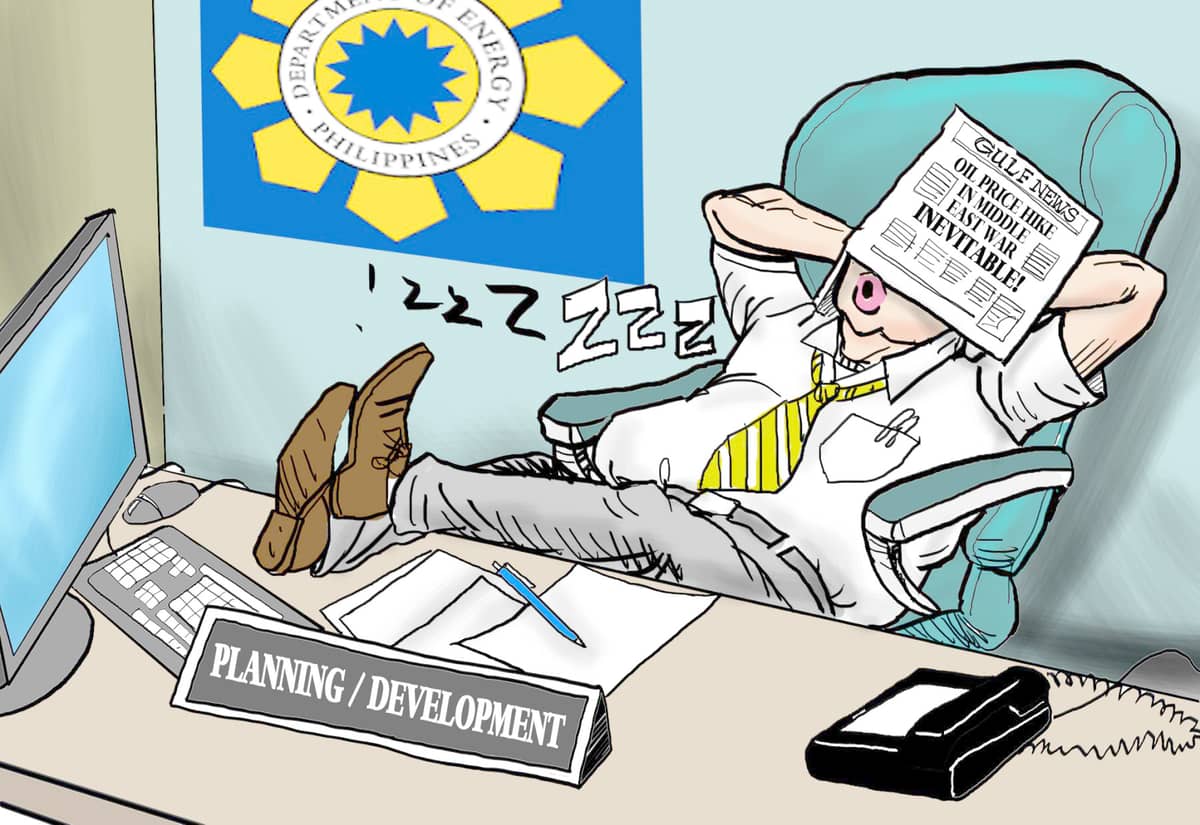
Consumer rights group Power for the People (P4P) urged the DoE to come up with a plan to protect electricity consumers from price shocks.
The Marcos administration must ensure that Filipino households are cushioned from the devastating blow of the latest US-Iran war on energy rates.
Price control measures, the recovery of questionable charges passed on by power companies to consumers, and other measures to provide relief were recommended.
The P4P group stressed that the US-Iran conflict is a wake-up call for the government, especially the DoE, to prioritize developing renewable energy distribution to households.
The DoE must prioritize the large-scale deployment of distributed renewables. These sources, especially rooftop PV systems, are both strategic in the long term and immediate solutions as they can be deployed in a matter of weeks.
This will minimize reliance on gas and coal in Metro Manila and major cities, and on oil-based products in island grids.
The country’s neighbors have already proven the feasibility of rapid renewable energy deployment, and the Philippines, with 91 GW of potential from solar rooftop systems alone, can do the same.