
ME war may jolt electricity bills: Bombing of refineries causes jitters


The Middle East (ME) crisis could trigger a domino effect, driving up not only fuel prices but also electricity rates.
Anticipating the fallout, authorities are weighing measures to cushion the impact of the widening conflict, including adjustments to the energy mix and possible cuts in excise taxes.
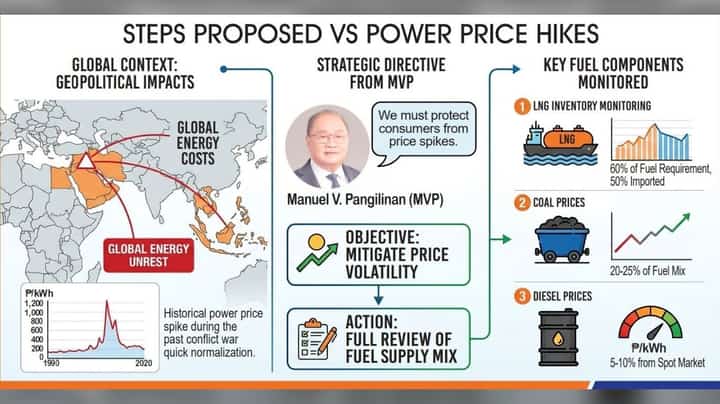
With power bills already elevated, Meralco chairperson Manuel V. Pangilinan has directed the utility to conduct a comprehensive review of its fuel supply mix to shield consumers from sudden rate spikes.
In a social media post on Wednesday, Pangilinan said the company will closely monitor its liquefied natural gas (LNG) inventory, as well as the prices of coal and diesel, all of which “We want to ensure an adequate supply of power and manage price volatility as responsibly as possible. (I) have made it clear to the team that we must help protect consumers as the cost of goods rises globally,” Pangilinan said.
Iran’s targeting of key fuel suppliers has scaled up jitters in the world market.
Saudi Arabia intercepted a drone attack targeting its massive Ras Tanura refinery, the defense ministry said on Wednesday, following an earlier hit on the complex along its Gulf coast this week.
“Initial estimates indicate that a drone carried out the attack but it did not result in any damage,” the ministry said in a statement posted on X.
Asia’s and Europe’s oil reserves could soften the immediate impact of the Middle East war that was sparked by the US and Israeli strikes on Iran, but a prolonged conflict could trigger major disruptions and sharp price increases, analysts warned.
Imports expose Phl
The Philippines is among the most exposed in energy terms.
Energy Secretary Sharon Garin said the government will carefully balance the country’s finances if it decides to partially reduce the fuel excise tax amid rising global oil prices.
In a radio interview on Wednesday, Garin said the possible tax adjustment would not be for the entire year and must therefore be weighed against its impact on government revenues.
President Ferdinand Marcos Jr. earlier said he may seek emergency authority from Congress to temporarily suspend the fuel excise tax if crude oil prices spike sharply due to the ongoing conflict in the Middle East.
Fuel prices in the Philippines continued to rise this week. As of Tuesday, 3 March, diesel prices increased by P1.20 per liter, while kerosene rose by P1.50 per liter, according to separate advisories from oil companies.
Garin said the Department of Energy may also assist public transport drivers if global oil prices reach a certain threshold.
The assistance may be provided through the Pantawid Pasada Program, which grants fuel subsidies to public utility vehicle drivers affected by rising oil prices.
Malacañang said it is studying various proposals to mitigate its effects, including the four-day workweek for all government agencies.
This was after President Ferdinand Marcos Jr. ordered austerity measures for government agencies, especially in energy use, as fuel prices might surge due to the Middle East conflicts.Castro said, unfortunately, programs that benefit from the collection of the excise tax might be adjusted and compromised in the meantime.
Conserve power use
Pangilinan, meanwhile, called on businesses and households to monitor their electricity use, pointing out that much of the country’s fuel for power is imported.
“It would also help if we’re mindful of our electricity consumption as the war in the Middle East continues. We can all help to have enough power to get through the next few weeks if we conserve power,” he added.
At present, 60 percent of Meralco’s fuel requirement comes from natural gas, half of which is imported. Coal accounts for 20 to 25 percent, renewable energy 10 percent, and the remaining five to 10 percent is sourced from the Wholesale Electricity Spot Market.
Meralco head of utility economics Larry Fernandez said that while Qatar is the largest supplier of LNG, the Philippines also sources natural gas from Malaysia and Australia, which are closer to the country and unaffected by the current conflict.
“It is correct that a large supply of oil as a source of energy comes from the Middle East. And not just oil, but also natural gas. So, if there are constraints to the supplies of oil and natural gas, like any other commodity, there is pressure for prices to go up,” Fernandez said.
“Now coal is another source of energy. So if other energy sources like oil and gas rise in price, there is also pressure on coal prices to rise. So that is one of the impacts we are watching in terms of global commodity prices given the situation in the Middle East,” he said.
Asked about the effect of the geopolitical tensions on Meralco power rates, Fernandez said March rates are unlikely to be affected, but prices could start climbing in April if the situation persists.
“The recent events in the Middle East do not affect March prices. At the very least, we may see an effect in April. Supply will be available and we are monitoring energy commodity prices. Prices will depend on how long the situation lasts,” Fernandez said.
He recalled that a similar conflict last year caused a one-month spike in energy prices, which quickly normalized once tensions eased.
Fernandez said the potential impact on local electricity rates will hinge on the duration of the Middle East conflict.
Meralco is set to announce its March rates next week. Last month, Meralco ended two consecutive months of declines after raising rates by P0.2226 per kilowatt-hour, bringing the total to P13.1734 per kWh from P12.9508 in January.