
War spreads, oil shock looms: Initial P4 per liter hike feared
While this week’s domestic prices have not yet factored in the Middle East tensions, next week could see a significant increase.
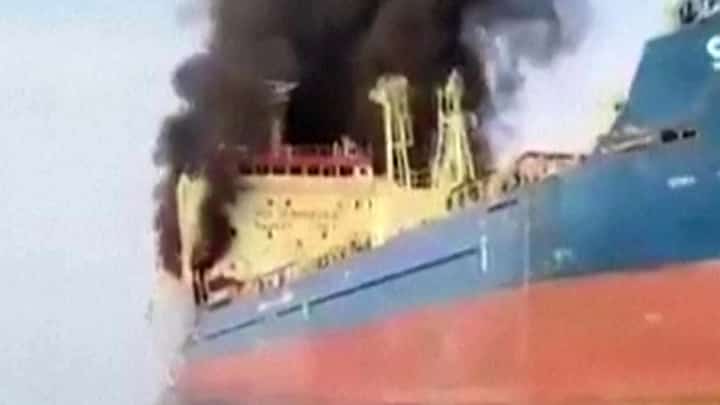
GULF fire rages The Palau-flagged tanker Skylight burns off Oman’s Musandam Peninsula after being struck, as US-Israel attacks on Iran ignite wider regional retaliation.
UGC/AGENCE FRANCE-PRESSE
The escalation of the Middle East conflict sent oil prices surging past $80 per barrel, with analysts warning they could climb as high as $100 if tensions persist.
In Asian trading, Brent crude briefly hit $82 per barrel — its highest level since July 2024 — before easing to around $77. Even at that level, prices remain roughly $5 higher than when markets closed on 27 February, prior to the US and Israel launching airstrikes on Iran.
Following Iran’s retaliatory strikes across multiple Middle Eastern countries, Israel’s renewed attacks on Lebanon, and reports of a strike on a UK airbase in Cyprus, market watchers cautioned that further escalation could propel oil toward the $100 mark.
Goldman Sachs estimates Brent could shoot to $110 per barrel while JP Morgan projects a surge to $120 to $130 per barrel. At those levels, airlines said they would start bleeding.
Prices would be driven higher primarily if Iran makes good on its threat to close the Strait of Hormuz, a key chokepoint in the global oil trade through which 15 percent of global oil demand and 20 percent of global liquefied natural gas (LNG) supply typically transit.
Iran has attacked multiple vessels since the war began, with the Iranian Islamic Revolutionary Guards Corps (IRGC) claiming three ships from the UK and US have been hit as it warned ships away from the strait, leading to insurers withdrawing coverage for vessels passing through it.
Sharp spike
Fresh tensions in the Middle East could hit Filipino motorists with a spike in fuel prices, underscoring the country’s heavy reliance on imported oil and its exposure to global market shocks.
Jetti Petroleum Inc. president Leo Bellas said Monday that early Mean of Platts Singapore (MOPS) indications, the regional benchmark for the deregulated local oil industry, showed diesel jumping more than $10 per barrel and gasoline climbing over $5 per barrel.
Bellas noted that these trends could translate to a P4-per-liter increase for diesel and around P2 per liter for gasoline if they continue.
Dubai crude, however, has yet to reach $80 per barrel, the threshold that automatically triggers a government-led distribution of fuel subsidies. Dubai crude last closed at $68.34 per barrel.
Different next week
Bellas cautioned that while this week’s domestic prices have not yet factored in the Middle East tensions, next week could see a significant increase if current MOPS trends persist.
“The latest tension in the Middle East has not been factored in yet in this week’s domestic price movement. For next week, however, if the sole basis is today’s potential MOPS prices, a significant increase may happen due to the big jump in oil and refined products prices seen at the start of this week’s trading,” he warned. “Hopefully, prices will no longer go up above current levels.”
Despite the pump price hikes, Bellas said most fuel retailers maintain at least the minimum 15-day inventory, likely closer to 30 days. Still, he warned that a prolonged supply disruption could push crude past $100 per barrel, even if major consumers like China release reserves to stabilize the Asian market.
Local fuel retailers have already announced increases in pump prices, adding P1.90 per liter to gasoline, P1.20 to diesel, and P1.50 to kerosene. These follow last week’s hikes of P0.60 per liter for gasoline and P1.20 for both diesel and kerosene.
The Middle East tensions have also drawn warnings from consumer group Power for People Coalition, which urged authorities to take action to protect consumers from steep price spikes.
The group emphasized that the Department of Energy and the Energy Regulatory Commission “must implement price control mechanisms to provide a reprieve to Filipino consumers,” noting that the country’s reliance on fossil fuels leaves it exposed to global shocks.
“The country is already heading into the summer season, usually marked by the highest electricity rates every year. With a volatile geopolitical situation that could further escalate, price control mechanisms must be the bare minimum in shielding electric consumers from sharp price hikes,” the coalition said.
Rizal Commercial Banking Corporation chief economist Michael Ricafort said the crude oil price peaked at US$78.40 per barrel in the attack by the US and Israel on Iran.
The increase in world prices, along with the weakening of the Philippine peso, “would lead to higher local pump prices and some pickup in overall inflation,” he added.
Federation of Philippine Industries chairperson Beth Lee, in a statement, said the Middle East crisis is “not just a distant conflict— it is an inflationary shock that could affect Philippine households and industries if tensions persist.”
She said higher global oil prices will lead to jumps in domestic oil prices, electricity prices, and transportation fares.
The Senate Energy Committee called for revising the fuel subsidy trigger formula for the public transport sector. It proposed shifting from a fixed price threshold to a percentage-based system, aiming to provide faster relief for public utility vehicle (PUV) drivers amid expected fuel price spikes.
Under the current Pantawid Pasada program, subsidies are released when world oil prices hit $80 per barrel.
A percentage increase in prices within a week should automatically trigger the release of funds for PUV drivers.
Bombs traded; US planes crash
Israel bombarded Lebanon on Monday following rocket fire from Hezbollah, several American warplanes crashed in Kuwait, and Iran lashed out against the region with missiles, as the war with Israel and the United States expanded.
A Saudi oil refinery was on fire after it was targeted, and black smoke rose from the US embassy complex in Kuwait as Iran pressed on with attacks it launched in retaliation for the US and Israeli campaign that killed its supreme leader, Ayatollah Ali Khamenei.
In Cyprus, an Iranian drone hit a UK military base, but no casualties were reported.
Black smoke rose from the US embassy in Kuwait on Monday, while US warplanes crashed without causing casualties, as Iran pressed on in a third day of retaliation in the Gulf.
A US base and a power station were also targeted in what was the most dramatic escalation for the small Gulf country in decades, after the 2003 US invasion of Iraq and Baghdad’s attempt to take over Kuwait in 1990.
Blasts also rang out over the Gulf cities of Abu Dhabi, Dubai, Doha, and Manama as Iran targeted America’s Gulf allies after the killing of its supreme leader in US-Israeli strikes.
The embassy in Kuwait did not announce it had been hit, but issued a security alert urging people to stay away.
The Iranian attacks have so far killed five people in the Gulf, including one person in Kuwait, according to authorities.