




ICC presents Duterte's 'high-value targets' on Day 2 of pre-trial hearing
Text size
International Criminal Court (ICC) prosecutors on Tuesday proceeded with the second day of the pre-trial hearing on crimes against humanity charges against former president Rodrigo Duterte, zeroing in on the killings of so-called “high-value targets” (HVTs) under the anti-drug campaign known as “Oplan Tokhang.”
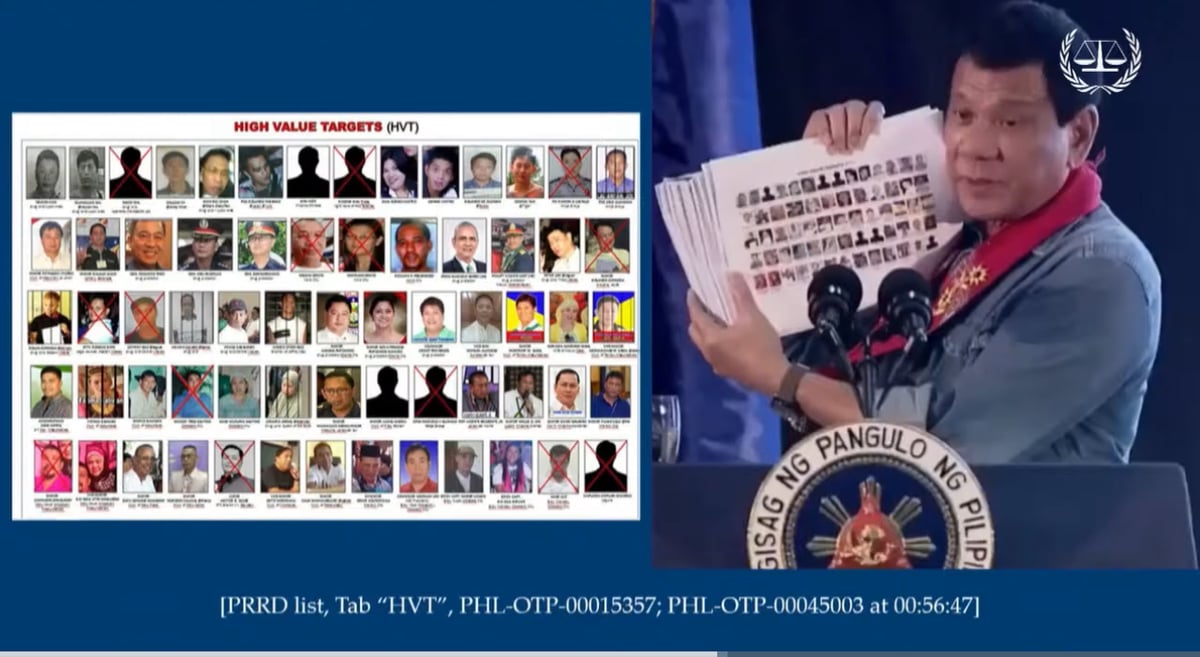
Prosecutor Edward Jeremy presented in court a copy of the so-called “PRRD list,” described as a spreadsheet containing the names and photographs of individuals tagged as HVTs allegedly linked to illegal drug activities.
Quoting the testimony of an unnamed witness, Jeremy said the list was used by police in conducting operations. “If you are on the list, you will be subject to police operations. And most of the time, the people on the list are killed. … So basically, the PRRD list is a dead list,” the witness’ statement read.
Among those identified as HVT was the late Rolando Espinosa, who was shot dead inside his jail cell in November 2016, allegedly after firing at police officers.
In a video clip presented as evidence, Duterte said he had ordered authorities to track down Espinosa, who, he claimed, was able to surrender to former Philippine National Police chief and now Sen. Bato de la Rosa before being “shot on sight like a dog.”
ICC prosecutors named De la Rosa as one of Duterte’s alleged co-perpetrators in the crimes against humanity case. He has been absent from Senate sessions since November amid speculation about a possible ICC arrest warrant.
Court submissions showed that alleged drug suspects were categorized into five levels. Level 1 included street-level dealers, lower-ranking government officials and police officers. Level 2 covered department heads, barangay chairpersons and sub-distributors.
HVTs were classified under Level 3, alongside senior government officials, members and executives of the judiciary, and law enforcement personnel. Level 4 included local drug lords, Chinese distributors and couriers, while Level 5 — the highest tier — comprised drug financiers, wholesalers, and high-ranking officials of the police and military.
Jeremy said Espinosa’s photograph on the PRRD list was later marked with a red cross, which a witness confirmed signified that the individual had been killed. The same list, prosecutors noted, had previously been shown by Duterte during a public address.
According to the prosecution, the killings were institutionalized through Command Memorandum Circular 16-2016, issued and signed by De la Rosa on 1 July 2016 — Duterte’s first day in office. The memorandum laid out guidelines for police units nationwide in implementing the anti-drug campaign dubbed “Project Double Barrel,” commonly known as Oplan Tokhang, following Duterte’s directive to eradicate illegal drugs within his first six months as president.
Prosecution witnesses claimed that operations frequently targeted poor communities, whose residents were less likely to file complaints due to financial constraints.
Jeremy argued that the nationwide killings were patterned after the so-called “Davao model,” allegedly implemented during Duterte’s tenure as mayor of Davao City, which purportedly offered monetary rewards to perpetrators in exchange for neutralizing suspected drug offenders.
He told the court that Duterte expanded the scheme to the national level upon assuming the presidency, and that funding for the operations did not come from official police budgets but was allegedly provided by Duterte himself, citing several public speeches.
Jeremy further said Duterte appointed alleged co-perpetrators from Davao to key positions in government and the police, giving them authority over thousands of state personnel who formed a nationwide network used to carry out the charged crimes.
The prosecution also presented video clips of Duterte publicly urging police and military personnel to kill criminals and suspected drug dealers, regardless of whether they resisted arrest.
Jeremy described Duterte as “well-versed” in the law as a former prosecutor who, at times, “seeks to legitimize his encouragement of state violence.”
In a 20 September 2016 speech before military troops, Duterte said, “For as long as I’m president, nobody but nobody, no military man or police man will go to prison because they performed their duties well. I will be the one to go to jail. Just say that it’s my order.” In the same address, he assured troops of pardons and promotions if they killed criminals.
Duterte, 80, faces three counts of murder involving 78 individuals — including six children — allegedly killed between 2013 and 2018, spanning his time as Davao mayor and president.
Count one covers 19 killings, including three children, allegedly carried out by the so-called Davao Death Squad during his mayoral tenure. Count two involves the killings of HVTs between 2016 and 2017 while he was president. Count three covers 45 deaths linked to barangay-level anti-drug operations during his presidency.
Duterte’s lead counsel, Nicholas Kaufman, has described the charges as “grievously misplaced and politically motivated.”
Housing is probably the biggest issue affecting people the world over.
Malacañang on Monday called for a more thorough investigation into the questioned flood control projects in Taguig…
The defense on Monday backed the move by senator-judges to exclude a prosecution witness who testified on the firearms…
