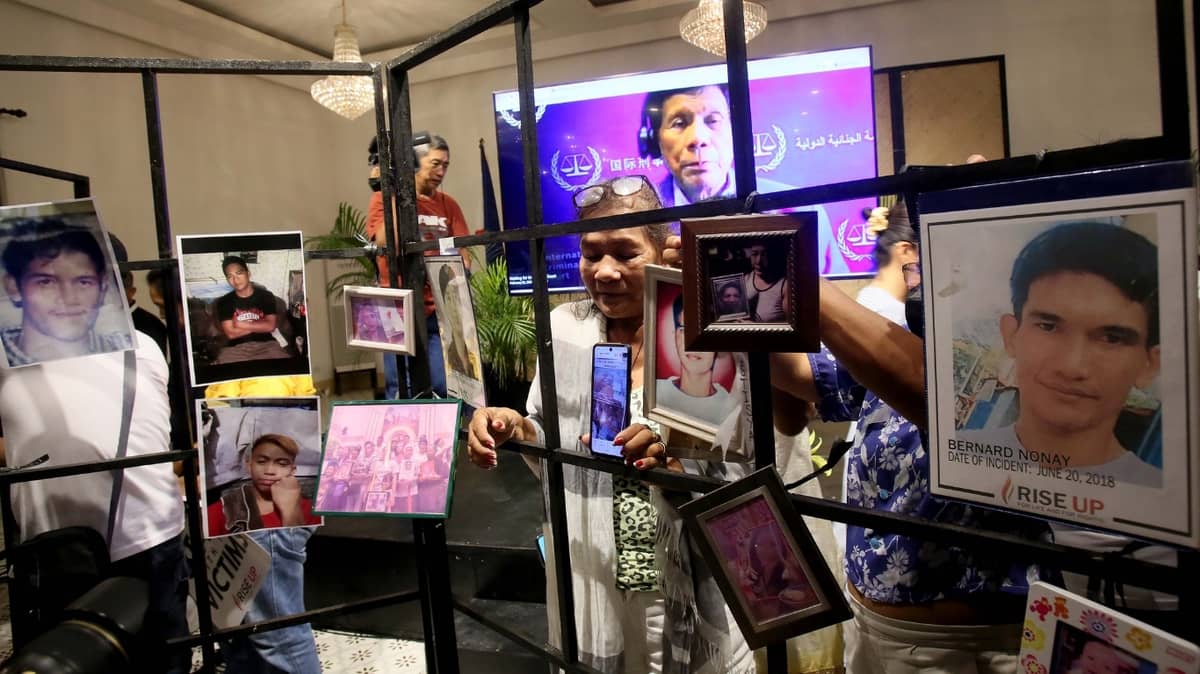
The confirmation of charges hearing for former President Rodrigo Duterte opened Monday at the International Criminal Court (ICC) in The Hague, with prosecutors and defense lawyers clashing over his war on drugs as judges decide whether he should face trial for crimes against humanity or return to the Philippines.
The pre-trial confirmation of charges hearing, running from 23 to 27 February, will determine if there is enough evidence to put Duterte on full trial for three counts of murder covering alleged extrajudicial killings during his tenure as Davao City mayor (2013–2016) and Philippine president (2016–2022).
Prosecutors laid out their case in Duterte’s absence; he is represented solely by his counsels, Nicholas Kaufman and Dov Jacobs, and has waived attendance.
Deputy Prosecutor Mame Mandiaye Niang said the killings under the charges are only “a fraction of the overall criminality” from Duterte’s anti-drug campaign, which rights groups estimate claimed as many as 30,000 lives, mostly among poor communities.
The charges are based on 78 named victims, including six children. Count one covers 19 killings, including three children, allegedly carried out by the so-called Davao Death Squad during Duterte’s mayoral tenure.
Count two involves 14 “high-value targets” killed nationwide between 2016 and 2017, while count three logs 45 alleged killings and attempted killings during barangay-level anti-drug operations under Duterte’s presidency. Prosecutors described these as part of a systematic and widespread attack on civilians.
Niang argued Duterte played a pivotal role by allegedly ordering police to “neutralize” individuals associated with drugs, providing cash rewards on top of salaries, equipping operatives with weapons and logistical support, and publicly endorsing killings through speeches and interviews.
She cited a 2015 televised interview in which Duterte vowed to “wipe out” criminals within 24 hours if elected president, saying such statements emboldened perpetrators and created a culture of impunity.
The prosecutor also highlighted a drop in killings when Duterte temporarily suspended operations, demonstrating his influence over the campaign.
Duterte’s defense hit back, led by Nicholas Kaufman, who called the charges “grievously misplaced and politically motivated.”
He insisted Duterte “stands behind his legacy resolutely. He maintains his innocence absolutely.” Kaufman acknowledged that his client was “a unique phenomenon” who was “gung-ho in his ways” and full of “hyperbole, bluster and rhetoric.”
However, he accused the prosecution of “cherry-picking” Duterte’s speeches, noting that many of them emphasize the importance of sticking to the law.
The defense also emphasized Duterte’s health and cognitive issues, including memory and executive function deficits, making it “practically impossible” for him to flee or obstruct justice.
Kaufman insisted that detention should be exceptional, questioned the ICC’s jurisdiction, and challenged the legality of Duterte’s transfer, portraying the proceedings as rushed and politically biased against the Philippines, the first major country outside Africa to face such a case.
Victims’ counsel Joel Butuyan warned that failing to confirm charges could endanger families of the victims, saying Duterte “will return home as a conquering hero” and could threaten witnesses in the Philippines.