
PBBM woos Leni with mega infras: Marcos denies politics but wears pink socks
The rivalry between Marcos and Robredo began in 2016, when both ran for vice president.


A MOMENTno one quite expected was immortalized when former rivals for the vice presidency (2016) and the presidency (2022) President Ferdinand R. Marcos Jr. (right) and Naga City Mayor Leni Robredo (center) met on Saturday, 21 February to inspect the Magaya-gaya Creek Oplan Kontra Baha in Barangay Concepcion Pequeña, Sitio Magaya-gaya Creek, Naga City (inset). With them (at left) is Department of Human Settlements and Urban Development Secretary Jose Ramon ‘Ping’ P. Aliling.
PHOTOGRAPHS BY YUMMIE DINGDING FOR DAILY TRIBUNE
Brushing off suggestions of a political alliance with his erstwhile rival, Naga City Mayor Leni Robredo, President Ferdinand R. Marcos Jr. declared, “Public service comes before politics,” but it seems actions speak louder than words.
Aside from kickstarting a flagship anti-flood program of his administration in Naga City, the President turned over P500 million for the renovation and retrofitting of the Jesse M. Robredo Coliseum (JMRC) named after the popular late husband of the mayor.
The rivalry between Marcos and Robredo began in 2016, when both ran for vice president of the country.
Robredo, then a congresswoman from Camarines Sur and a member of the Liberal Party, narrowly defeated Marcos by about 263,000 votes in a highly contested race that led Marcos to file an electoral protest, which was dismissed by the Supreme Court in 2021.
Both have clashing ideologies: Robredo is aligned with the anti-Marcos movement that ousted the Marcos family in 1986, while Marcos seeks to rehabilitate his family’s legacy.
The tension escalated into a rematch during the 2022 presidential election, which Marcos ultimately won.
The President was in Robredo’s turf yesterday after he inspected the Oplan Kontra Baha (OKB) operations in the city. Robredo and other local officials welcomed him warmly.
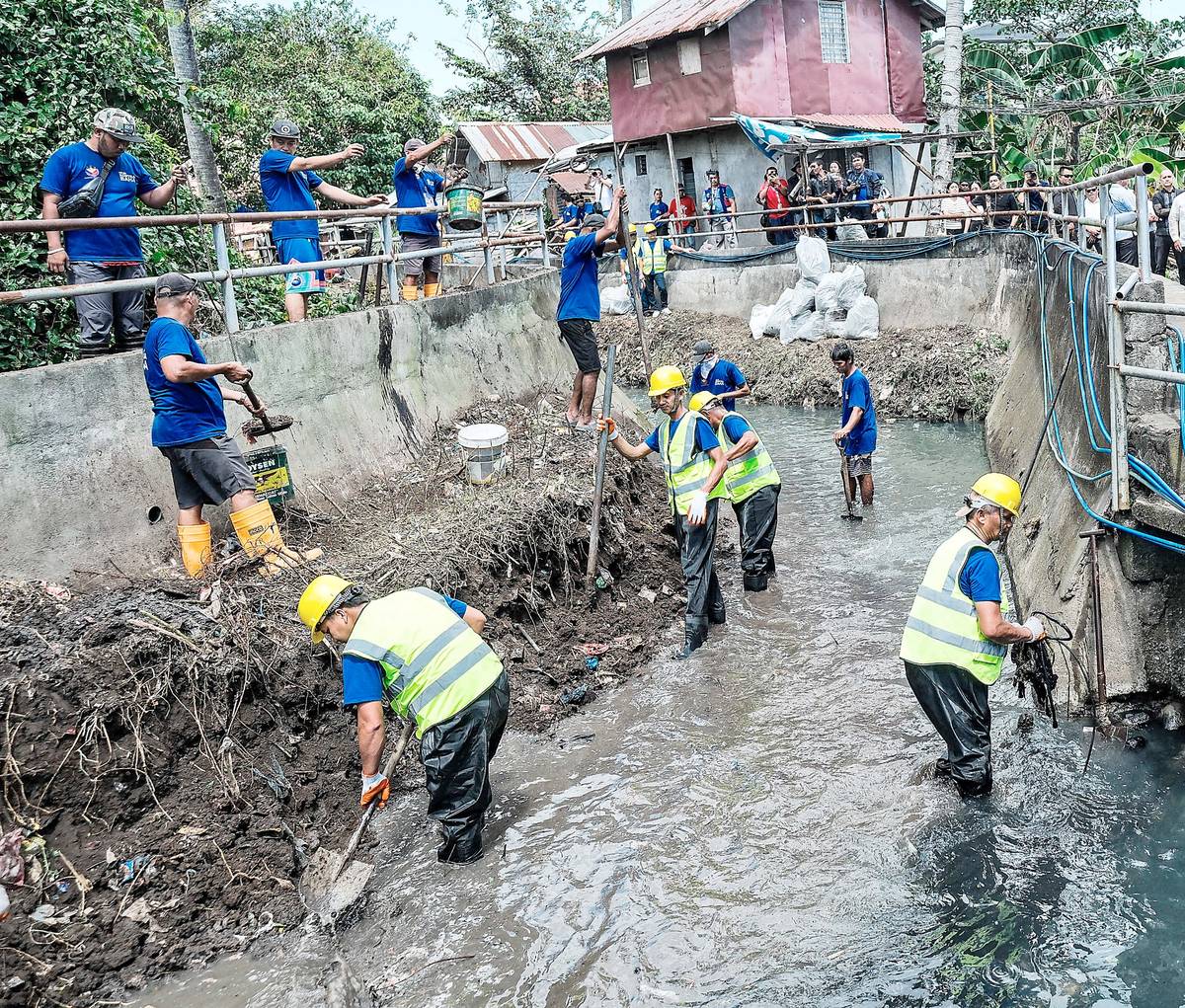
A MOMENTno one quite expected was immortalized when former rivals for the vice presidency (2016) and the presidency (2022) President Ferdinand R. Marcos Jr. (right) and Naga City Mayor Leni Robredo (center) met on Saturday, 21 February to inspect the Magaya-gaya Creek Oplan Kontra Baha in Barangay Concepcion Pequeña, Sitio Magaya-gaya Creek, Naga City (inset). With them (at left) is Department of Human Settlements and Urban Development Secretary Jose Ramon ‘Ping’ P. Aliling.
PHOTOGRAPHS BY YUMMIE DINGDING FOR DAILY TRIBUNE
During the visit, Marcos handed over a Special Allotment Release Order (SARO) worth P500 million to fund the modernization of the coliseum.
The project includes installing a community kitchen capable of feeding thousands during disasters, improving sanitation facilities, upgrading the roof, and strengthening the structure.
Marcos was quick to brush aside talk of a political alliance, insisting that the focus of his visit was the city’s worsening flooding problem.
“We’re not talking about that. You know, I think the mayor (Robredo) will agree with me that it’s service first before politics,” the President said.
Lightening the mood, Marcos added, “The most political thing that we did today, I wore my pink socks, my pink socks in honor of Mayor Leni.”
Pink was the political hue of Robredo during her 2022 presidential campaign.
Search for Sara foe
On the heels of Vice President Sara Duterte’s declaration that she will seek the presidency in 2028, the scramble for a strong candidate to match her popularity has begun.
While names have been floated as a possible successor to Marcos, none have the capability to match up with Duterte at this time.
Critics of Duterte were unanimous in pointing to Robredo as the only figure who can put up a semblance of a good fight.
“I don’t see anyone else but former Vice President Leni as the strongest candidate we in the opposition can field,” House senior minority deputy leader Caloocan City Rep. Egay Erice said.
“For the country, she must run. Because PBBM and Vice President Sara ran together for president. They promised unity, they promised change, but they failed,” he added.
“So both of them should be accountable for this failure,” Erice pointed out.
While Robredo had shut down talk of her being the opposition frontrunner, Erice said, “Nothing is impossible. Everything under the sun is possible. As of now, it hasn’t even been discussed yet whether she will run. As for the issue of whether the opposition will unite under one banner, that’s what the opposition is considering.”
“Many names are being considered. But as far as I’m concerned, the strongest candidate with a chance to win is former Vice President Leni,” Erice said.
No political color
President Marcos stressed that he would not engage in political discussions during the visit, emphasizing that his presence in Naga City was aimed at helping resolve what he described as a “very critical issue” — the flooding that affects not only Naga City but the wider province of Camarines Sur and the Bicol Region.
“That’s what we are concentrating on,” he said, underscoring the national government’s readiness to extend assistance to local government units.
“That’s why whoever is in need, the national government is here to help. I came from local government, that’s why I have great sympathy for the situations of local government,” Marcos said.
The OKB was started on 18 February in Naga City and will run until 31 July 2026.
The initiative covers 29 rivers and creeks and two lakes, and includes the large-scale cleaning and clearing of the city’s drainage system.
The project aims to improve water flow, reduce flood risk, and strengthen disaster preparedness in a region frequently battered by typhoons.
The funding will also support enhancements to the drainage system to prevent flooding within the coliseum complex and the establishment of dedicated medical response areas for emergencies.
The initiative aims to bolster the local government’s disaster preparedness and response capability, enabling faster and more efficient action during typhoons, earthquakes, and other crises.
Key Naga structure
The JMRC is popularly known as the “Big Dome of the South” and can seat 12,000 people and accommodate up to 15,000 for standing-room events.
It regularly hosts basketball games, concerts, school tournaments, and major cultural gatherings in the Bicol Region.
Over the years, the JMRC has also served as a key evacuation and relief center. It has withstood powerful storms, including super typhoon “Rolly” and typhoon “Kristine,” as well as several earthquakes, without sustaining major structural damage.
During typhoon “Kristine,” while much of Naga City was submerged in floodwaters, the coliseum remained dry and functioned as a logistics hub for relief distribution across Camarines Sur.
Not spur of moment visit
In a media interview during his inspection of the OKB operations, the President said plans to review flood control efforts in Naga had been underway for months.
“We know that Bicol is always the pathway of the storms. The immediate problem that we saw is the intensity of the rainfall. It wasn’t this heavy before,” Marcos said.
The President noted that Naga City recorded approximately 700 centimeters of rainfall in a single day, a volume he noted that reflects the intensifying impact of climate-related weather events.
Marcos said his visit to Sagop Creek in Barangay Triangulo demonstrated the government’s commitment to long-term flood mitigation and disaster resilience, not only in the Bicol Region but across the country.
He also inspected the Sitio Magaya-gaya Creek in Barangay Concepcion Pequeña as part of the OKB inspection.
Local officials and residents welcomed the President’s visit and renewed push for sustained waterway rehabilitation.
Meanwhile, Alvin Caquilala, Engineer II of the Department of Public Works and Highways-Region 5, explained that years of neglect had left Sagop Creek heavily clogged, worsening the flooding in nearby communities.
“It hasn’t been reached by flowing water for a long time because it is severely clogged. This became a bigger problem, especially during typhoon Kristine, as the impact was significant. The flooding took a long time to subside and the water level rose considerably,” Caquilala recalled.
Flood control upgrades underway
The DPWH is accelerating the dredging, declogging, and rehabilitation of Sagop Creek and nearby waterways, with the projects expected to restore drainage capacity and curb recurring floods in one of the Bicol Region’s most flood-prone urban areas.
Interventions are focused on the 10-kilometer creek, which traverses the flood-prone barangays of Del Rosario, Concepcion Grande, Concepcion Pequeña, Triangulo, and Tabuco, all located within the Bicol River Basin catchment.
The Sagop Creek rehabilitation is part of Oplan Kontra Baha, a nationwide flood mitigation program that prioritizes rapid interventions such as dredging rivers, declogging canals, rehabilitating pumping stations, removing illegal obstructions, and maintaining flood-control infrastructure.
“Naga City was selected as a pilot area for Oplan Kontra Baha due to its high susceptibility to flooding within the Bicol River Basin and its experience of severe typhoon-induced flooding, highlighting the need for focused and sustained flood-mitigation efforts,” the DPWH said.
The agency said it is mobilizing equipment and personnel to sustain operations in high-risk areas, with Naga City serving as a pilot site for similar flood mitigation efforts being implemented in Metro Manila, Cebu, and Bacolod, and planned expansions in Laguna, Iloilo City, and Cagayan de Oro.
These measures complement ongoing flood control initiatives under the Bicol River Basin Development Program, which aims to strengthen the infrastructure and reduce the impact of severe weather events in the region.