
Safe power, communications cables bill approved by House on final reading
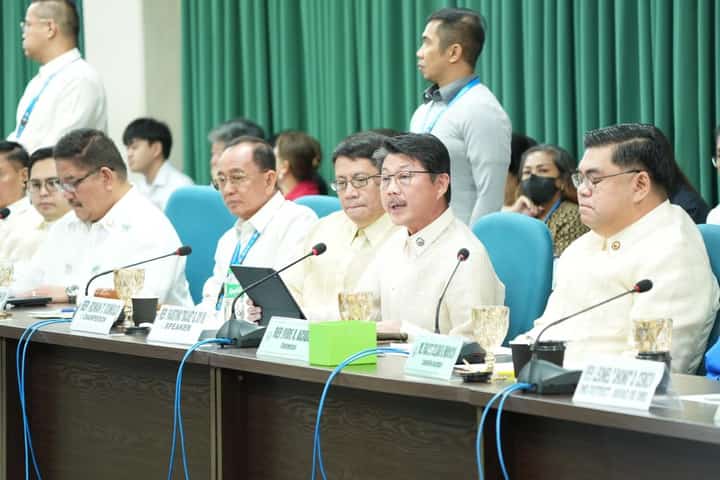
A measure mandating electric distribution, cable and telecommunications companies to take full responsibility for the safety, maintenance and orderly management of overhead power and communication lines, imposing fines of up to P2 million on repeat offenders who fail to comply with inspection, clean-up and safety standards was approved by House of Representatives under the leadership of Speaker Faustino “Bojie” G. Dy III on Wednesday on third and final reading.
Voting 223 affirmative votes, the proposed House Bill (HB) No. 7565 or the Safe Overhead Electric Distribution, Cable, and Communications Lines Act, hurdled the plenary and was passed on final reading.
House Majority Leader Ferdinand Alexander “Sandro” A. Marcos, one of the principal authors of the measure, of Ilocos Norte, said the bill squarely addresses long-standing safety hazards in communities across the country.
“This bill makes it clear that utilities cannot simply leave hazardous wires hanging above our streets. They have the responsibility to maintain safe, orderly and compliant systems because public safety must always come first,” Marcos said.
“We are setting uniform standards and meaningful penalties so that compliance becomes the norm, not the exception. This is about protecting lives, safeguarding property and ensuring that our infrastructure keeps pace with development,” Marcos added.
Utilities, in the said bill, are required to conduct periodic inspections, remove dangling and unused wires, bundle and secure active lines, replace damaged or leaning poles, and ensure proper clearances in accordance with the Philippine Electrical Code, placing the burden squarely on service providers to protect life and property.
Fines ranging from P250,000 to P500,000 for a first offense, P500,000 to P1,000,000 for a second offense, and P1,000,000 to P2,000,000 for third and succeeding offenses, underscoring the chamber’s intent to compel strict compliance.
The bill also lists as authors Reps. Jurdin Jesus M. Romualdo, Noel “Bong” N. Rivera, Jaime R. Fresnedi, Antonino B. Roman III, Brian Poe, Eleandro Jesus F. Madrona, Mauricio G. Domogan, Antolin A. Oreta III, Charisse Anne C. Hernandez, Roberto “Pinpin” T. Uy Jr., Salvador A. Pleyto, Ma. Nina Francesca P. Lacson, Walfredo “Arman” R. Dimaguila Jr., Jesus “Bong” C. Suntay, Maria Cristina C. Angeles, Claudine Diana D. Bautista-Lim, Angelo Marcos Barba, John Tracy F. Cagas, Danilo “Danny” A. Domingo, Sergio C. Dagooc, Caroline B. Agyao, MD, Esmael G. Mangudadatu, Yevgeny Vicente B. Emano, King Collantes, Nelson S. Legacion, Gil “Kabarangay Jr” Acosta, Agatha “Agay” A. Cruz, Jose C. Alvarez, Miguel Luis R. Villafuerte, Kristine Singson-Meehan, Presley C. De Jesus, Julius Cesar “Jay” V. Vergara, Rosalie Ang Salvame, Arthur C. Yap, Isidro D. Lumayag, Maximo Y. Dalog Jr., Romeo S. Momo Sr., Maximo B. Rodriguez Jr., Mark Anthony G. Santos, Roy M. Gonzales, Rachel Marguerite B. Del Mar, Jose Manuel “JM” Floirendo Lagdameo, Nathaniel M. Oducado, Lorenz Defensor, Sonny Lagon and Christopherson “Coco” M. Yap.
Earlier, the proposed bill hurdled the House Committees on Energy and on Information and Communications Technology before securing plenary approval, reflecting broad support for stronger regulatory standards amid growing public concern over hazardous cable clutter and unsafe utility poles in urban and rural areas.
The measure beyond imposing obligations on utilities, institutionalizes regular and systematic inspections by requiring electric distribution, cable and telecommunications firms to undertake periodic audits of their overhead lines and to coordinate clean-up and rehabilitation activities within their service areas.
To strengthen enforcement at the local level, the bill mandates the creation of a Monitoring and Service Team in every city and municipality, which will conduct semi-annual inspections, oversee the removal of unused cables and monitor the replacement of defective poles and unsafe installations.
Local government units are likewise given a central role in ensuring compliance, with authority to pass implementing ordinances within 60 days from the effectivity of the implementing rules and regulations and to withhold or deny the renewal of business permits of non-compliant utilities operating within their jurisdiction.
The measure at the national level creates an Inter-Agency Committee chaired by the Energy Regulatory Commission, composed of key government agencies and LGU representatives, tasked to set uniform standards, coordinate nationwide clean-up efforts and monitor adherence to safety requirements.
It also encourages the joint use of poles and utility structures to reduce visual clutter and improve efficiency, subject to safety and engineering standards, in a bid to rationalize the growing web of overhead lines in densely populated communities.
When relocation or reinforcement of cables and poles becomes necessary due to public infrastructure projects, the measure provides that the implementing agency or private project proponent shall shoulder the cost, preventing delays in government works while clarifying financial accountability.