
P96.5-M 'ghost' flood-control project haunts DPWH Davao Occidental
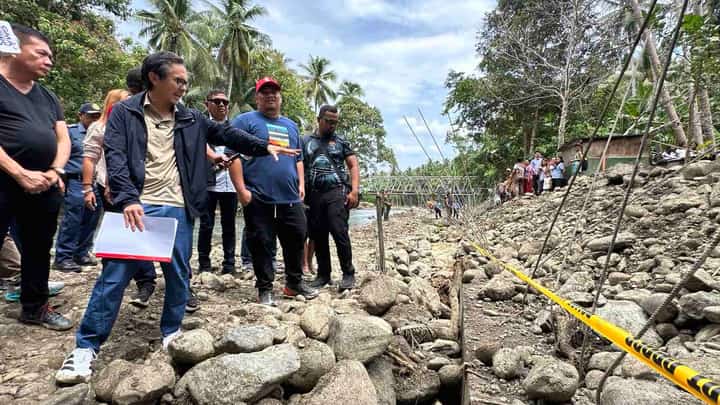
Documents obtained by DAILY TRIBUNE and accounts from highly placed sources point to a P96.5‑million flood‑control project in Jose Abad Santos, Davao Occidental, that appears to have existed only on paper, even as it was certified completed and fully paid by the Department of Public Works and Highways (DPWH).
The case is now the subject of a complaint before the Office of the Ombudsman, implicating district‑level public works officials and a contractor allegedly tied to firms that cornered multiple projects in recent years.
At the center of the controversy is Project No. 22LE0029, described in official records as the “Construction of Concrete Revetment, Culaman, Sta.0000–Sta.2000, Jose Abad Santos, Davao Occidental,” with an approved budget of P96,500,000.
According to the complaint‑affidavit executed by DPWH Secretary Vivencio B. Dizon, the project was awarded on Jan. 13, 2022, to St. Timothy Construction Corporation, with a contract signed Feb. 23, 2022, for P96,460,004.02. Less than eight months later, on Oct. 4, 2022, District Engineer Rodrigo C. Larete certified the project as completed, and documents show that St. Timothy was fully paid through three partial payments in 2022 and a final payment in early 2023. A Certificate of Final Acceptance dated Nov. 14, 2023, formally closed the project as “satisfactorily completed in accordance with plans and specifications,” according to paperwork seen by the Tribune.
The narrative shifted on Sept. 25, 2025. Acting on a report through the “Sumbong sa Pangulo” platform, Dizon, together with Baguio City Mayor Benjamin Magalong and law‑enforcement operatives, conducted an ocular inspection of the supposed revetment site. An independent commission working with the Criminal Investigation and Detection Group (CIDG) later reported a “ghost flood control project,” where construction had reportedly started only about three weeks before their visit. The commission’s report identifies St. Timothy as one of 15 contractors that cornered the most DPWH projects over the past three years, raising concerns over systemic vulnerabilities in project awarding and oversight.
Contradictions between official records and the site were reinforced by a joint affidavit executed Sept. 29, 2025, by local officials Juanito Tagilansang Salminang, Reynold Miguel Malantic, and Victorino Sugpat Venancio. In their sworn statement, they recounted being surprised by the sudden arrival of the Secretary and his team to inspect “the construction around the bridge,” saying the revetment works had begun only in August 2025. They said they learned only during that visit that the project had long been reported by DPWH as finished and fully paid, even though they had “never saw any prior construction of revetment” in the area. The witnesses also said Engr. Larete purportedly explained the revetment had been completed earlier but had been “ruined by floods” — a claim they dispute.
The complaint‑affidavit submitted to the Ombudsman details how payments were processed. It names public respondents including Larete, Engr. Michael P. Awa, Engr. Joel M. Lumogdang, Engr. Harold John E. Villaver, Engr. Jafael C. Faunillan, Engr. Josephine C. Valdez, Engr. Ranulfo A. Flores, and Czar Ryan S. Ubungen, all of the DPWH Davao Occidental District Engineering Office. Private respondents are St. Timothy Construction Corporation, represented by Ma. Roma Angeline D. Rimando, and businesswoman Cezarah Rowena C. Discaya, identified “by her own admission” as the firm’s beneficial owner.
Documents show the first partial payment of P29,564,991.23 was processed Feb. 28, 2022, covering work from Feb. 24–28, 2022, with supporting statements certifying materials on site and work completed. Subsequent payments followed the same pattern, with certificates, inspections, and approvals signed by the same cluster of officials. The final payment of P42,971,147.31 on Jan. 12, 2023, allegedly completed the project, accompanied by similar supporting documents and certifications.
Sources following the case say the repetition of names across critical documents suggests a “closed loop of mutual validation.” The complaint alleges that public and private respondents “acted in concert” to facilitate fraudulent release of funds for a project “when no actual work was actually undertaken,” using falsified reports and certifications.
The DPWH Secretary is asking the Ombudsman to investigate for violation of Section 3(e) of Republic Act No. 3019 (the Anti‑Graft and Corrupt Practices Act), malversation of public funds under Article 217 of the Revised Penal Code in relation to RA 10951, and falsification of public documents under Articles 171 and 172 of the RPC.
The complaint highlights Discaya’s role as beneficial owner of St. Timothy and alleges the company, through Rimando and Discaya, “fraudulently acted with public officials to secure full payment for a ‘ghost project,’ and is therefore liable as a co‑conspirator.”
The National Bureau of Investigation confirmed that the Regional Trial Court in Lapu‑Lapu City, Cebu, issued warrants of arrest against Discaya in connection with multiple criminal cases arising from flood‑control projects, including the Davao Occidental ghost revetment. She was taken into custody and is now detained while her motions and trial on graft and malversation charges proceed.
In his affidavit, Dizon links the case to the Marcos administration’s anti‑corruption drive, noting the September 2025 inspection was conducted “pursuant to such commitment.”
As of now, official documents and residents’ accounts form one side of the story. The respondents have yet to secure a definitive ruling on motions to quash charges, and the courts and Ombudsman have not finally decided whether the allegations will proceed to full trial.
For a remote barangay at the edge of Jose Abad Santos, the paper existence of a P96.5‑million flood‑control project—and the late-arriving concrete works that locals say started only in 2025—has become a stark symbol of the gap between anti‑corruption rhetoric and real accountability.