
Google powers up in scam war
New features aim to spot scams, flag fakes

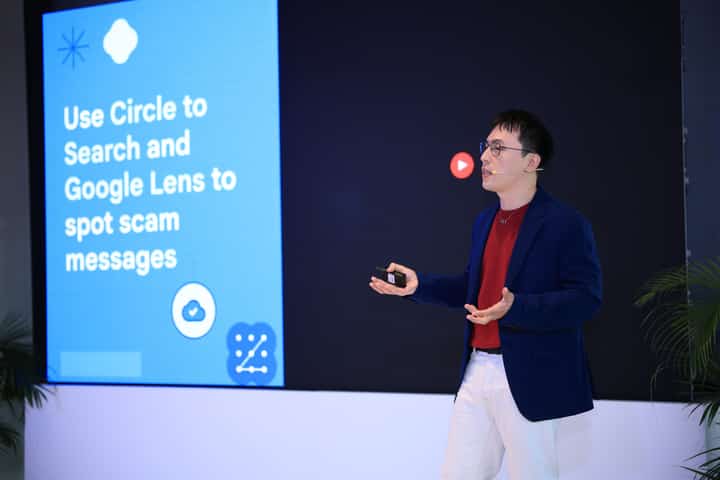
During the 2026 Safer Internet Day event, Google PH head of communications and public affairs Mervin Wenke discusses the AI tools and tips to help Pinoy netizens navigate the internet safety including the new capabilities of Circle to Search and Google Lens to fight scams.
Photograph courtesy of Google Philippines
TAGUIG CITY — Google Philippines on Tuesday marked Safer Internet Day with the launch of new artificial intelligence-powered tools designed to help Filipinos distinguish scams from legitimate content, fact-check information and strengthen digital security.
The initiative, themed “sA Internet, Ingat!”, highlighted updates across Google’s ecosystem that aim to detect fraudulent messages in real time, block malicious apps and protect devices from theft.
Prep Palacios, country manager of Google Philippines, shared a personal experience with online fraud to underscore the urgency of digital vigilance.
“I messaged the seller. We had a very professional exchange. The moment I sent my payment, the account vanished. All the messages disappeared. Just like that I lost 90,000 pesos,” Palacios said.
“It wasn’t really just about the money. It was the realization of how easily I got manipulated. I don’t want anyone to make my mistake.”

Prep Palacios, country manager for Google Philippines, emphasized the importance of online safety tips and tools, especially in the age of AI.
Photograph courtesy of Google Philippines
She urged users to verify online identities and seek assistance from authorities such as the Cybercrime Investigation and Coordinating Center.
“If there’s one lesson to take away here, we really need to be critical. We need to verify that the people we talk to online are truly who they say they are,” she said.

Standing from left to right to mark Safer Internet Day are Putri Alam, director of government affairs & public policy for Google Southeast Asia; Usec. Aboy Paraiso of the Cybercrime Investigation and Coordinating Center; and Mervin Wenke, head of communications and public affairs for Google Philippines.
Photograph courtesy of Google Philippines
Undersecretary Aboy Paraiso, executive director of the CICC, said cybercrime is evolving alongside AI technologies.
“Earlier this month, the CICC launched our ‘AI-AI Feb-ibig’ because in the first month of 2026 alone, we have already seen a surge in AI-driven love scams,” Paraiso said.
“Scammers aren’t just using masks anymore, they are using sophisticated algorithms to mimic human emotion.”
Paraiso said consumer fraud accounted for 38 percent of all reported cybercrimes in the Philippines in 2025, with most cases originating from lapses in data privacy.
“Emotions can bypass the firewall of even the smartest digital native,” he said. “It’s one thing to get fooled by humans. It’s sadder that we get fooled by technology.”
He said the CICC is strengthening coordination with the Bangko Sentral ng Pilipinas and expanding scam safety initiatives to address AI-enabled threats.
Google said its product updates are built on three principles: secured by default, private by design and user control.
Among the tools highlighted were Circle to Search and Google Lens, which allow users to analyze suspicious messages. By taking a screenshot or encircling text on an Android device, users can prompt Google AI to assess whether a message is likely fraudulent.
“Our AI analyzes the message and tells you in real time if it’s likely a scam or not. It’s like having a security expert looking over your shoulder,” said Mervin Wenke, head of communications and public affairs of Google Philippines.
Google also cited enhancements to Google Play Protect, which automatically detects and blocks high-risk applications before installation. Financial scams remain among the top digital threats in the country, Wenke said.
To address physical device theft, Google introduced upgrades to Android Theft Protection. The feature uses AI to detect suspicious motion patterns linked to snatch-and-run incidents and automatically locks the device. Additional identity checks help prevent unauthorized access to sensitive settings and banking applications.
Beyond device security, Google said it is expanding protections against misinformation and AI-generated manipulation.
The company has watermarked 10 billion AI-generated items using its SynthID technology to help users identify AI-created content. Its experimental tool, Backstory, provides context on images, including whether they were generated by AI and where they have appeared online.
Google also promoted its Family Link feature, which allows parents to set screen time limits, approve app downloads and apply content filters. Updated controls for YouTube Shorts enable parents to set specific viewing limits, including zero minutes per day.
“These tools are not just about restrictions, it’s about intention,” Wenke said.
Education-focused initiatives were also highlighted, including Experience AI, developed with the Raspberry Pi Foundation and Google DeepMind, and AI Quests, a gamified program introducing children to real-world AI applications.
Wenke said Google Trends data shows Filipinos are actively searching for cybersecurity-related terms, including “computer virus,” “trojan horse,” “keystroke logging,” “one-time password” and “media literacy.”
“The thirst for safety is the first step toward a more resilient digital Philippines,” he said.
Palacios said online safety conversations must extend beyond a single awareness day.
“We need to make sure that we equip ourselves with the right technology,” she said. “These tools are in your hands right now to ensure that your data stays secured all the time.”