
Ferry sinks off Basilan; 18 dead, dozens missing
Among the casualties are women and children, including an infant.
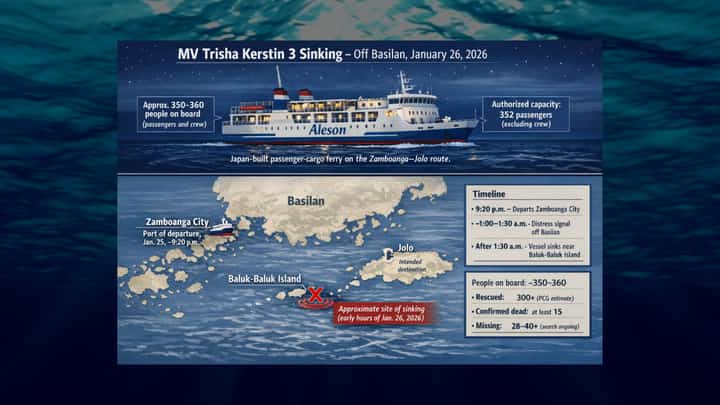
SEA-WORTHY? Passenger-cargo vessel MV Trisha Kerstin 3, which sank off Basilan in the early hours of Monday, was built in 1995 and reflagged for Philippine service in 2010. It carried over 350 passengers over rough seas where the mishap happened.
Illustration courtesy of Chatgpt
A desperate search continued Monday in the dark waters off Basilan after a passenger ferry carrying more than 350 people sank before dawn, leaving at least 18 confirmed dead and dozens still missing, according to the Philippine Coast Guard (PCG).
The MV Trisha Kerstin 3, a 44-meter, triple-deck passenger-cargo vessel, sent out a distress call at around 1:50 a.m., roughly four hours after departing Zamboanga City at about 9:20 p.m. Sunday for Jolo, Sulu. Shortly after the alert, the ferry sank about 5 kilometers east of Baluk-Baluk Island, near Hadji Muhtamad, Basilan, in reportedly rough seas.
Rescue teams raced against time as survivors struggled to stay afloat in the darkness. Many were found clinging to floating debris, life rafts, and pieces of the ship.
At least 316 passengers and crew have been rescued, Coast Guard Commander Romel Dua said, but between 28 and more than 40 people remain unaccounted for as of Monday morning. Among the casualties are women and children, including an infant, according to local officials.
A massive, multi-agency rescue operation is now underway.
Coast Guard vessels, Navy boats, and PNP Maritime units are sweeping the area, while Coast Guard and Air Force aircraft, including a Black Hawk helicopter, scan the Sulu Sea from above. Fishermen were among the first to respond, pulling survivors from the water and turning them over to PCG ships, including BRP Tubbataha, for transport to safety.
Hospitals in Isabela City, Basilan, and Zamboanga City were quickly overwhelmed as survivors arrived suffering from hypothermia, exhaustion and trauma. Basilan emergency responders admitted they were short-staffed as dozens of patients were rushed in.
The Department of Social Welfare and Development (DSWD) has begun profiling survivors and families of victims for emergency aid, while local governments coordinated shelters and food assistance.
Officials said early indications do not point to overloading. Commander Dua confirmed the ferry was carrying 332 passengers and 27 crew, within its authorized capacity.
Survivors, however, told authorities they heard a loud impact and noticed seawater rushing into the vessel shortly before it listed and capsized.
The Coast Guard said a full marine casualty investigation will be launched once search-and-rescue operations are completed.
For now, all efforts remain focused on finding the missing. As rescue boats and aircraft continue to comb the waters near Basilan, families wait anxiously onshore — clinging to hope that more survivors will still be found in one of the country’s most harrowing maritime disasters in recent years.
Island travel risks
The sinking of MV Trisha Kerstin 3 is the latest in a long line of deadly maritime accidents in the Philippines, an archipelago of more than 7,000 islands where millions rely on ferries for daily travel. Safety advocates have long pointed to aging vessels, rough seas, inconsistent enforcement of regulations, and overreliance on sea transport as persistent risks — particularly on remote southern routes.
Notable disasters include the 1987 Doña Paz tragedy, when more than 4,000 people died after the ferry collided with an oil tanker, making it the world’s worst peacetime maritime accident. In 2015, a passenger boat capsized in Ormoc Bay, Leyte, killing over 60 people. More recently, in 2023, at least 30 passengers died in a fire aboard a ferry in the southern Philippines.
Authorities insist that MV Trisha Kerstin 3 was not overloaded, but the incident once again highlights the dangers faced by passengers traveling between islands — especially during night crossings — and renews calls for stricter safety oversight and emergency preparedness across the country.
31-year-old Japan-built ship
The ill-fated ship is a passenger cargo vessel, a RORO-type interisland ferry serving one of the busiest sea corridors in the south.
Operated by Aleson Shipping Lines, a major player on the Western Mindanao and Sulu–Tawi-Tawi routes, the ship was built in Japan in 1995 and previously sailed there under the name Camellia II before being acquired by Aleson around 2010 and reflagged for Philippine service.
Since then, it has been deployed primarily on southern runs, including its regular night sailing from Zamboanga City to Jolo, Sulu, a route that takes it past the waters off Basilan where it met its fate.