
Classrooms as frontlines: Why climate education is now a test of national resilience
Climate change must now be understood not only as an ecological crisis, but as a human capital crisis.


We often speak of education as our first line of defense against climate change. But a nation cannot defend itself with a weapon that is being steadily dismantled.
In the Philippines, climate change is no longer only damaging coastlines and crops. It is disrupting classrooms, shortening school years, and quietly eroding the country’s future capacity to adapt.
Class suspensions triggered by extreme heat, schools damaged by floods, and prolonged closures after typhoons are no longer rare interruptions. They are becoming structural features of our education system. But what is being lost is not only infrastructure, but learning time — and learning time is human capital in formation.
This is why climate change must now be understood not only as an ecological crisis, but as a human capital crisis. A country that repeatedly interrupts the education of its young is not merely absorbing disaster damage; it is weakening its future workforce, its future leadership, and its future capacity to govern.
Filipinos already sense this danger. A recent assessment by the Philippine Institute for Development Studies found that nine out of ten Filipinos consider climate change a serious problem. Few public issues command that national level of near consensus.
But near consensus is not the same as capability. Concern without comprehension does not produce resilience. Rather, it produces uncertainty. A nation that fears climate change but does not fully understand its mechanics, its risks, and its policy choices remains exposed to misinformation, short-term thinking, and reactive politics.
Many students already know what climate change feels like. They have lived through suffocating heatwaves, violent typhoons, and flooded streets. What too many still lack is a clear understanding of why these events are intensifying, how risks accumulate across systems, and how individual behavior, community planning, and government policy interact to either reduce or magnify harm.
This gap matters because climate change is not only a scientific problem — it is a governance problem. The quality of a country’s decisions under risk depends on the quality of its public understanding. Climate literacy, therefore, is no longer a niche educational concern. It is a condition for effective democratic governance.
This is where education becomes strategic.
Climate education is not merely about adding content to a curriculum. It is about strengthening the transmission chain of resilience across society. What begins in the classroom should and must go beyond the classroom. A climate-literate student becomes part of a more prepared household. Prepared households form safer communities. Safer communities enable more capable local governments. And capable local governments are the foundation of a resilient nation.
The argument holds: This is how national resilience is built — not only from the top down through policies and budgets, but from the ground up through knowledge and judgment embedded in daily life.
In this sense, education is not only an object or instrument of climate policy. It is democratic infrastructure. It shapes whether citizens respond to risk with foresight or with improvisation, with cooperation or with blame. A climate-literate public is harder to mislead, harder to panic, and harder to govern poorly.
This is why climate change is not merely testing our weather systems — it is testing our governance systems. A society that understands risk can plan ahead. A society that does not understand risk remains trapped in cycles of reaction and regret.
This national logic is already reflected in the country’s climate frameworks.
The Philippines’ very first National Adaptation Plan, developed under the administration of President Ferdinand R. Marcos Jr., recognizes that resilience is built not only through physical infrastructure, but through people and institutions — through the capacity to understand risk, plan ahead, and reduce vulnerability before disasters strike. Similarly, the Nationally Determined Contribution Implementation Plan affirms that climate action depends on informed participation across sectors and levels of government, not merely on national targets or technical measures.
These frameworks treat climate action as a whole-of-society effort. That is precisely why education matters. Policies succeed only when communities can understand them, local governments can apply them, and citizens can sustain them.
Through the Climate Change Commission, the government has been working to translate these national strategies into action on the ground — by strengthening Local Climate Change Action Plans, localizing climate risk information, and supporting LGUs in integrating science into development planning and public investment. But even the strongest national frameworks depend on a population that can absorb and apply them.
Climate education is therefore not an accessory to adaptation policy. It is part of the operating system that allows adaptation policy to function.
When students understand how hazards evolve, how ecosystems protect communities, and how public choices shape risk, they become adults who can engage meaningfully with planning, budgeting, and accountability. They become citizens who can support long-term reforms rather than demand short-term fixes. In this way, education does more than prepare students for storms and heatwaves. It prepares society for better governance.
As climate impacts intensify, delay carries a cost. Every cohort that passes through our schools without climate literacy is a missed opportunity to strengthen households, communities, and institutions. Every year of inaction compounds future vulnerability.
As we observe International Education Day, we should move beyond ceremonial recognition. In a warming world, classrooms are no longer just places of instruction. They are frontlines of national resilience.
A country that climate-proofs its schools — physically and intellectually — is not only protecting education. It is protecting its future capacity to govern, to grow, and to endure.
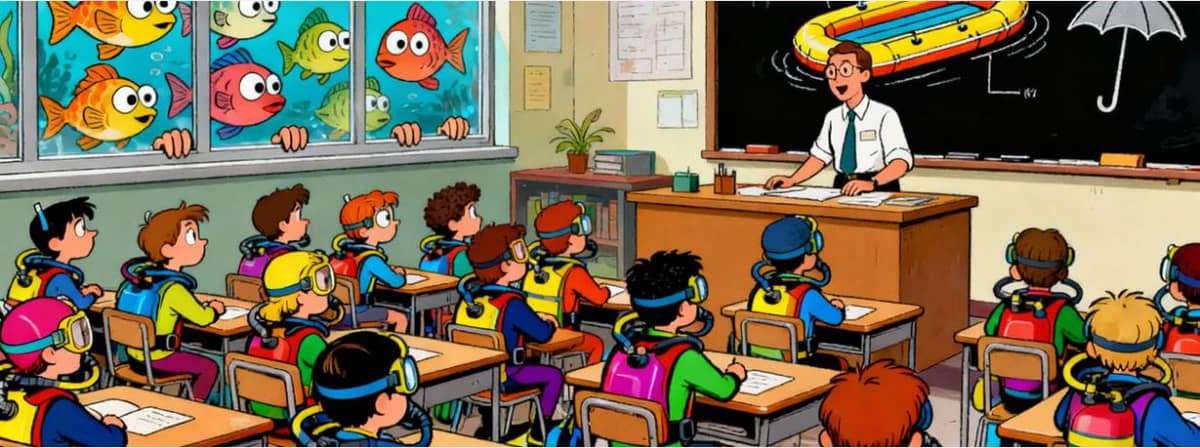
MANY students already know what climate change feels like.
Photograph courtesy climate literacy