
Restraint urged, DFA readies help
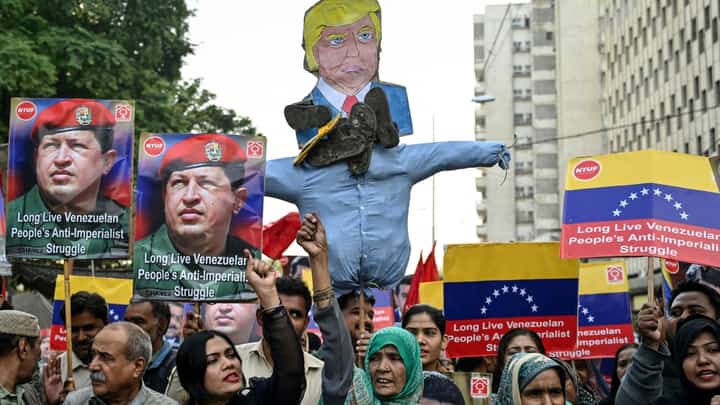
ACTIVISTS in Karachi, Pakistan hold placards and chant slogans during a protest against the United States' military strikes on Venezuela and the capture of President Nicolás Maduro and his wife, Cilia Flores. The dramatic US operation targeted military sites in Caracas and surrounding areas, culminating in Maduro's extraction and transfer to New York to face drug-trafficking charges after a months-long escalation in tensions between President Donald Trump and the Venezuelan leader.
The Philippines called for restraint among concerned parties and assured Filipinos of assistance as it closely monitors the rapidly evolving situation in Venezuela following reported United States military action.
“The Philippines is closely monitoring the evolving situation in Venezuela,” the Department of Foreign Affairs (DFA) said in a statement.
“The Philippines urges concerned parties to resolve disputes through peaceful means, and to exercise restraint to prevent an escalation of conflict.”
The DFA said the Philippine Embassy in Bogotá, Colombia, which serves as the country’s non-resident mission to Venezuela, has issued a travel and safety advisory and stands ready to assist Filipinos in the country.
“The Philippine Embassy in Bogota has issued a travel and safety advisory to Filipinos in Venezuela, and stands ready to provide assistance to them, as necessary and appropriate, to keep them out of harm’s way,” the DFA said.
Filipinos in Venezuela were advised to remain alert, stay informed, and keep a list of emergency contacts. They may also contact the embassy through its official Facebook page or via email at bogota.oe@dfa.gov.ph.
74 Pinoy expats
The DFA said it has so far logged 74 Filipinos in Venezuela.
The advisory comes amid heightened international alarm after US President Donald Trump announced that the United States had captured Venezuela’s long-time leader, President Nicolas Maduro, following overnight military strikes in and around the capital, Caracas.
Venezuelan authorities have denied the claim. Mr. Maduro accused Washington of attempting to seize control of Venezuela’s oil reserves, the largest in the world.
US officials, however, said Maduro was taken to the United States to face multiple charges, including narcoterrorism conspiracy, stemming from a 2020 indictment filed in New York during Trump’s first term.
In a statement, the US Attorney General said Maduro and his wife would face “the full wrath of American justice on American soil, in American courts.”
Venezuela has since declared a state of national emergency, with casualty figures and the full extent of the damage from the strikes yet to be confirmed.
Further, the Venezuelan government denounced the US action as an “extremely serious military aggression,” following months of escalating tensions marked by a US military buildup off Venezuela’s coast, deadly strikes on alleged drug trafficking vessels, and the recent seizure of sanctioned oil tankers.
The crisis has drawn strong reactions from the international community. United Nations Secretary-General António Guterres said he was “deeply alarmed” by the escalation, warning of its potentially far-reaching implications for the region.
“These developments constitute a dangerous precedent,” UN spokesperson Stéphane Dujarric said, stressing the need for full respect for international law and the UN Charter.
Guterres called on all parties to engage in inclusive dialogue grounded in human rights and international law.
UN High Commissioner for Human Rights Volker Türk also urged restraint, saying, “The protection of the people of Venezuela is paramount and must guide any further action.”
Venezuela has formally requested an emergency meeting of the UN Security Council, which is scheduled to convene at 10 a.m. Monday in New York.
Meanwhile, President of the UN General Assembly Annalena Baerbock emphasized that the UN Charter must remain the guiding framework in the days ahead.
“The UN Charter is not an optional document,” Baerbock said, noting that Article 2 requires all member states to refrain from the threat or use of force against the political independence or territorial integrity of any nation.
“A peaceful, safe, and just world for everyone is only possible if the rule of law prevails instead of might makes right,” she warned.
Senator Risa Hontiveros condemned what she termed as an act of aggression against Venezuela.
Some experts pointed out that the US is likely to have violated the terms of the United Nations charter, which was signed in October 1945 and designed to prevent another conflict on the scale of the Second World War.
A central provision of this agreement — known as Article 2(4) — stipulates that states must refrain from using military force against other countries and respect their sovereignty.
In a statement, Hontiveros said the recent unprovoked strike by the US against Venezuela “constitutes a grave violation of international law.”
“Not only has this action jeopardized the lives of Venezuelans, who have long endured the oppression of their own dictator; it has also placed other nations at risk of invasion and violence from foreign powers that may wish to abuse their might for their own interests,” she continued.
Troubling development
The seizing of Maduro “could send troubling signals to the international community,” Senator Imee Marcos on Sunday, 4 January, said
The senator pointed out that the situation in Venezuela “underscores long-standing concerns regarding the role of major powers in the internal affairs of states they consider strategically important.”
She noted that the US has various points in history has been associated with policies that have supported political transitions or leadership changes in countries such as Iraq, Afghanistan, Libya, Panama, Nicaragua, and the Philippines.