
From Jamón to Yema Rolls
Since Kris has not been in the best of health in recent years, I don’t expect anything this season. All I want is for her to be well again. Never mind the fruit salad — it would make me fat anyway.

Due to hard — and changing — times, gift-giving during the holiday season had already evolved over the last few decades. Until the 1980s, standard Christmas presents were clothes (even textiles to be fashioned by the neighborhood modiste), plaster-of-Paris knick-knacks, and picture frames.
Food gifts were hardly given, except among the lower class whose homes were connected by a network of callejones (alleyways). Those in low-income brackets swapped ube jalea (jam made of purple yam) or leche flan.
In the first few Christmases after the war — when times were truly difficult — hard-up godparents gave their ahijados (godchildren) a few pieces of native oranges: dalandan or “sintures,” as Batangas natives call the fruit. A cash gift from ninongs without steady income amounted to five centavos.
Among the rich who preferred to give food during the holidays, there were practically only two choices: fruits or jamon de funda. Fruits were usually red apples. Truly impressive, however, were the huge golden (yellow, actually) delicious apples — about a dozen neatly arranged in a wicker basket and covered in cellophane.
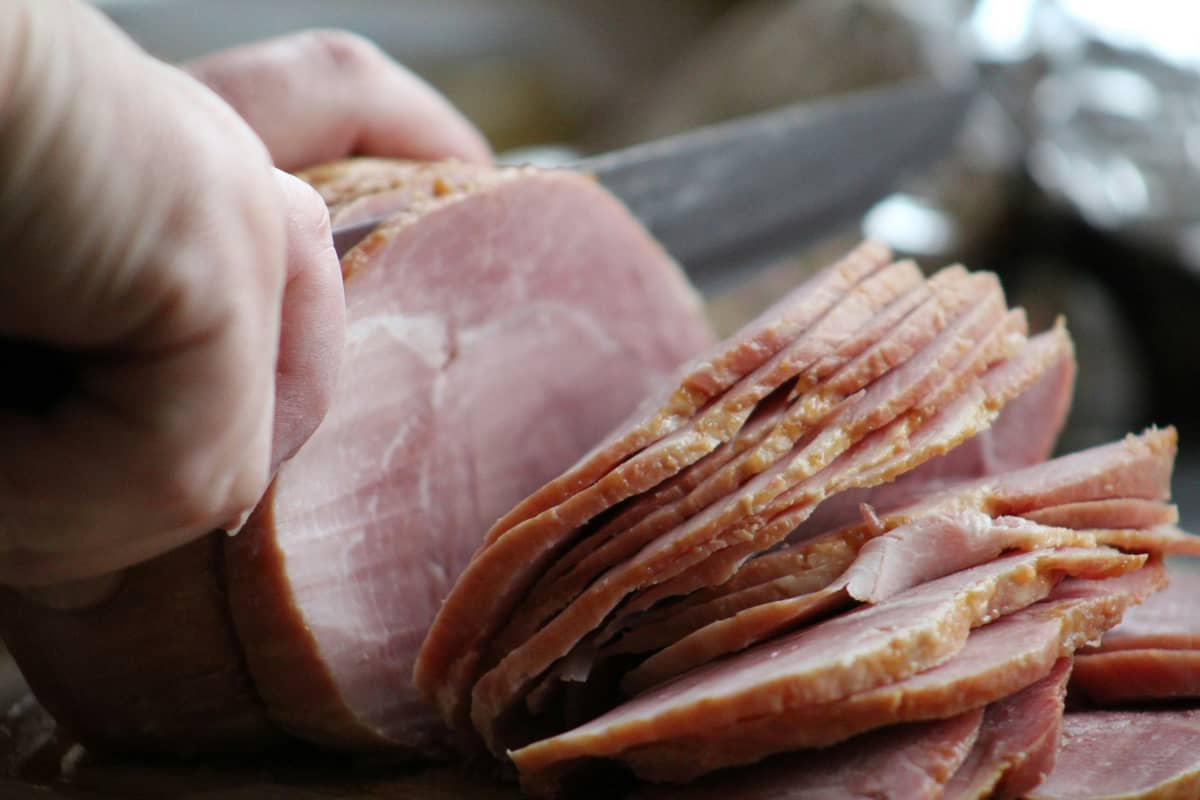
IT’S not Christmas without ‘jamon.’
Photograph courtesy of Julia Fiander/Unsplash
The jamon de funda (literal translation: pillowcase) was the only ham available in the market. There were no cooked legs of ham sold in groceries in the pre–shopping mall era. It was usually given wrapped in brown paper and encased in what looked like a fishnet stocking.
The jamon was rock-hard and had to be cooked for about 10 hours. The working mother skipped the office for a day just to prepare it. First, she sawed off the protruding bone. Then she boiled it for hours in pineapple juice and 7-Up (there was no Sprite yet) — sometimes beer. As a finishing touch, the jamon was smothered in sugar, caramelized by pressing it with a stainless-steel turner heated over fire. Pina-plancha was the vernacular term.
Today, with everyone pressed for time, people still give hams for Christmas — but already cooked. The hams passed around are usually rolled into balls weighing about a kilo, hardly a whole leg, which can now only be purchased by those with transactions with the Department of Public Works and Highways.
The taste has changed, too. The jamon of past Christmases tended to be salty, while today’s grocery-bought ham is sweetish. Recipients are grateful nonetheless, because what is noche buena without jamon?
Another popular Christmas food gift was fruitcake, which eventually became a joke because it was endlessly regifted. What most Filipinos did not realize was that until the 1970s, fruitcake was a precious item that came only from the United States or Vietnam.
Because of the Vietnam War, US military bases there stocked American goodies, including fruitcake. Vietnam became the nearest source of this treat, appreciated only by Filipinos with sophisticated tastes.
By the mid-1970s, glazed fruit became available in specialty stores in Divisoria. Housewives began baking fruitcake in batches starting October. Every night, like a ritual, each loaf was sprinkled with sherry brandy. By Christmas, the fruitcake was moist, with a pronounced liquor taste.
Production was commercialized in the 1990s and quality suffered. That was when fruitcake became a joke. Today, good fruitcake is hard to find. It has been replaced by food for the gods, brownies and any food item that can hold through the holidays.
People have become more practical. They prefer food gifts to shirts that may not fit or items that are not even their color.
Among showbiz people, food has also become the safest Christmas present. When I still lived in our family home behind Miriam College in Katipunan, friends in the industry looked forward to my yema rolls — tiny chiffon cakes rolled with delicate custard filling. I took offense every time Carlos Siguion-Reyna called them pianono.
My yema rolls may look like pianono, but they are not. The texture is soft, and the custard is creamy. Senator Loren Legarda described them as “malinamnam” — delicious in a heavenly way.
Unfortunately, the store where I bought them, Shoppersville in Katipunan, no longer exists. It caught fire a few years ago. Driving to Katipunan now feels like entering the inner chambers of hell, so I no longer visit the family home. These days, I give away tubs of otap from a regular supplier.
Other friends in the business also have signature food gifts. For a time, Korina Sanchez gave away blueberry cheesecake she made herself. It melts in the mouth and keeps you asking for more — lighter, though not less creamy.
Another Christmas treat I hanker for is Ai-ai de las Alas’ personalized ice cream, Ai’s Cream, made with gata (coconut milk). Rich but not heavy, it was clearly artisanal.
When I asked where I could buy it, Ai-ai told me to ask for something else. The business belonged to her ex, and they were no longer on speaking terms.
So I now make do with Geno’s ice cream from Bataan. Its gabi flavor comes close, though Ai’s Cream was creamier.
A wish fulfilled this Christmas was Bibeth Orteza’s tuyo in olive oil, delivered two weeks ago. She had been giving this to friends even before she became Mrs. Carlos Siguion-Reyna. Making it was a joint effort between Bibeth and Carlitos.
I only care about getting my share. There is nothing like coming home after a long day and eating rice with tuyo in olive oil. It’s like dying after traffic and waking up in heaven.
The one food gift I miss is Kris Aquino’s fruit salad, originally her mother Cory Aquino’s recipe. It had fruit cocktail and pineapple tidbits, with lychees added. Kris later added canned mandarin oranges, making it even richer.
Since Kris has not been in the best of health in recent years, I don’t expect anything this season. All I want is for her to be well again. Never mind the fruit salad — it would make me fat anyway.