
#OdettePH survivors sue Shell over climate harms
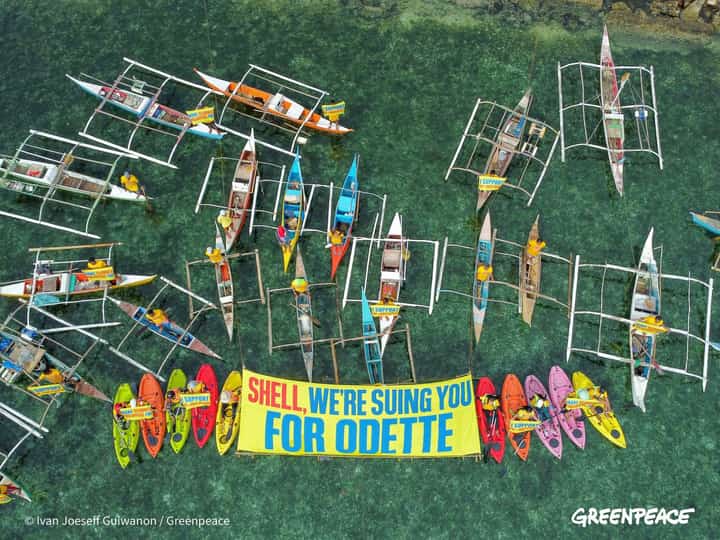
A group of survivors of 2021’s Typhoon Odette has filed a lawsuit in the United Kingdom against British oil giant Shell, seeking financial compensation for damages caused by the storm, three non-government organizations (NGOs) announced Thursday.
British law firm Hausfeld, representing 103 survivors, argues that Shell’s carbon emissions contributed to climate change, which scientists say is intensifying typhoons. In their joint statement, the NGOs described the legal action as “a decisive step to hold oil giant Shell accountable for the deaths, injuries and destruction left by the climate-fuelled storm.” The statement was co-signed by the Philippine Movement for Climate Justice and the Legal Rights and Natural Resources Center.
The claimants are seeking compensation for lives lost, injuries sustained, and homes destroyed, and the NGOs said the case forms “a vital contribution to the growing global push to challenge the impunity of fossil fuel companies.”
Typhoon Odette (international name Rai) devastated the Philippines nearly four years ago, causing an estimated P17.8 billion in agricultural losses and roughly P30 billion in infrastructure damage. More than 400 people were killed, and hundreds of thousands were left homeless.
The lawsuit comes as Shell—along with other major energy firms—faces rising scrutiny for scaling back climate targets while increasing its focus on oil and gas to boost profits. In March 2025, Shell disclosed that it spent only $8 billion of its $10–15 billion renewable-energy budget for 2024, while raising shareholder distribution targets and cutting capital spending guidance for 2025–2028. The company also increased cost-reduction goals, moves that prioritize returns over accelerated investment in lower-margin clean-energy ventures.
One of the claimants, fisherman's wife Trixy Elle, said their family home and four boats were swept away in the storm surge. They are still paying off high-interest loans used to rebuild.
“Island residents like us contribute only a small percentage of pollution. But who gets the short stick? The poor like us,” the 34-year-old told Agence-France Presse. She added that her 13-year-old son continues to suffer trauma from the storm.
The Philippines experiences an average of 20 storms annually; this year alone, 22 have struck the country. A Senate Economic Planning Committee report released in January estimated that natural disasters cost the Philippines around P911 billion between 2000 and 2023, in addition to the widespread loss of lives and livelihoods.
Momentum for climate-related litigation has been growing globally. In May, a German court ruled that companies could, in principle, be held responsible for damage linked to their emissions—raising expectations for similar action elsewhere.
Responding to the UK lawsuit, a Shell spokesperson said: “This is a baseless claim, and it will not help tackle climate change or reduce emissions.”