
Diokno, Remulla, Carpio-Morales warn flood-control scandal exposes deep corruption failures

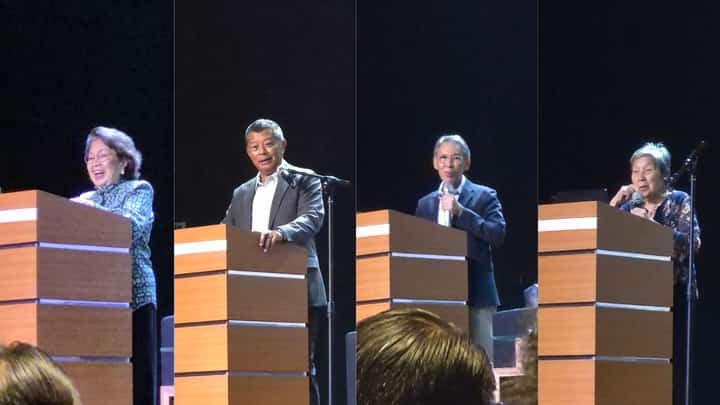
The flood control probe has reignited concerns over corruption, accountability, and governance as prominent legal and economic experts warned that systemic weaknesses continue to enable the misuse of public funds.
During a recent colloquium, former Sandiganbayan Presiding Justice Amparo Cabotaje-Tang underscored that public office is a duty, not an entitlement.
“Public office is not a right to enjoy, but a trust to be faithfully discharged,” she said.
Tang explained the “threefold liability rule,” which allows erring public officials to be held civilly, criminally, and administratively liable for wrongdoing involving public funds.
“A public officer may be held civilly, criminally, and administratively liable… This is the so-called threefold liability rule.”
She cited Republic Act 6713 and Republic Act 3019 as crucial safeguards, emphasizing that ethics and anti-graft provisions must carry real weight.
“These norms are not decorative. They should be treated as binding legal ethical duties.”
“It penalizes, among others, the act of a public official who causes undue injury… through manifest partiality, evident bad faith, or gross inexcusable negligence.”
Representative Chel Diokno pointed to systemic delays and institutional oversight failures, noting that thousands of corruption cases have remained unresolved for decades.
“It almost made me fall out of my chair,” he said, referring to corruption cases pending since 1987.
“If we have courts that will allow our money, cases involving our money to remain pending for decades, that is a reflection of how unimportant it appears to us as a society to fight corruption and to have accountability.”
Diokno also pushed for transparency reforms, including easier access to Statements of Assets, Liabilities and Net Worth (SALNs) and opening bicameral sessions to the public.
“It provides the baseline from which we can determine if an official is acquiring ill-gotten wealth.”
“Everything should be open to the public.”
Former Ombudsman Conchita Carpio Morales identified poor implementation — not the lack of laws — as the root of the problem.
“We have a good number of laws… but sadly, however, these laws are not properly implemented, if implemented at all.”
She cited the normalization of election bribery and corruption in infrastructure funding.
“During the 2020 interim elections, vote buying was so endemic that votes were bought for as much as 60,000 pesos per vote.”
Morales suggested blockchain adoption to enhance transparency, but warned its integrity depends on qualified and ethical implementers.
“The solution to the problem is to use blockchain technology.”
“Technology may facilitate the mitigation of corruption… but it must be handled only by well-trained technologists with integrity, high competence, and good moral values.”
Current Ombudsman Jesus Crispin Remulla confirmed ongoing actions in the flood control case and noted the politicization of infrastructure funding in Congress.
“Flood control has become a currency," Remulla said.
Economist Solita Collas-Monsod detailed the economic toll of corruption, stressing that it weakens institutions and deepens inequality.
“Higher corruption adversely affects key social indicators such as income inequality, educational levels, and poverty.”
“Corruption retards the emergence of strong institutions… it attracts talented people to unproductive activities.”
The colloquium highlighted that the flood control probe is more than a corruption scandal — it is a warning that without full enforcement of anti-graft laws, fiscal transparency, and structural reforms, public funds will remain vulnerable to political exploitation.