
HK scientist hopes saving endangered cockatoos
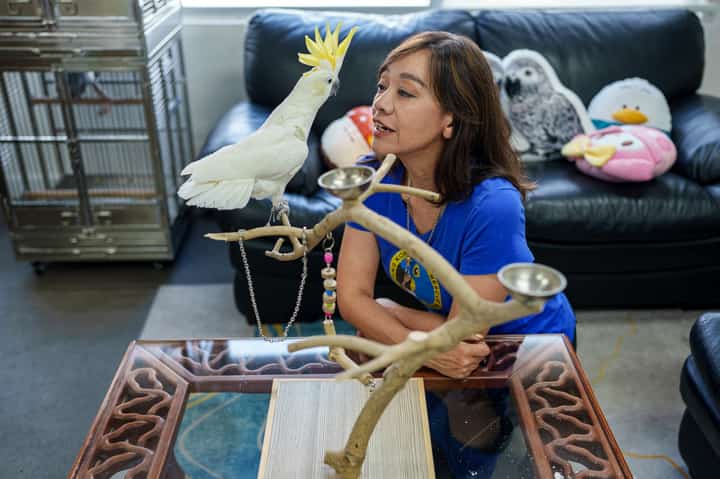
SHARON Kwok Pong, founder of the Hong Kong Parrot Rescue, interacting with ‘Winnie’, a rescued yellow-crested cockatoo, in Hong Kong. Above the teeming shopping streets of Hong Kong’s Causeway Bay district, a fight to save one of the world’s most endangered species is unfolding high in the branches of a decades-old cotton tree. Nestled among its sprawling boughs is a nest box designed for the yellow-crested cockatoo, of which only 1,200 to 2,000 remain in the world.
YAN ZHAO/AGENCE FRANCE-PRESSE
HONG KONG (AFP) — Above the teeming shopping streets of Hong Kong’s Causeway Bay district, a fight to save one of the world’s most endangered species is unfolding high in the branches of a decades-old cotton tree.
Nestled among its sprawling boughs is a nest box designed for the yellow-crested cockatoo, of which only 1,200 to 2,000 remain in the world.
Although the birds are native to East Timor and Indonesia, one-tenth of those left are found in Hong Kong — one of the “largest cohesive remaining wild populations” globally, according to Astrid Andersson, a postdoctoral researcher at the University of Hong Kong.
Their future now hangs in the balance, due to habitat loss and, some suspect, a black market for the rare birds.
The cockatoos’ numbers have stagnated, with far fewer juveniles than when Andersson began monitoring almost 10 years ago.
The birds don’t make their own nests but depend on natural cavities in trees — about 80 percent of which have vanished in recent years, because of typhoon damage and government pruning.
The nest boxes set up by Andersson are an attempt to rectify this, designed to resemble the hollows sought out by the birds.
She plans to place about 50 around the city.
“Without the nest boxes, I believe that the cockatoos will have fewer and fewer opportunities to increase or replace individuals that die in their population,” she said.
The boxes will also allow observation of their reproductive behavior, which has never been comprehensively studied.
The cockatoos’ existence in Hong Kong has been “a very positive story about human-wildlife coexistence,” Andersson said.
The population in Hong Kong is an introduced one, with one urban legend recounting they originated from an aviary set free by the British governor of Hong Kong before surrendering to the Japanese in 1941.
There is no evidence to support that story, however — the modern flock’s ancestors are in fact believed to be escaped pets.