
DENR intensifies Marikina reforestation
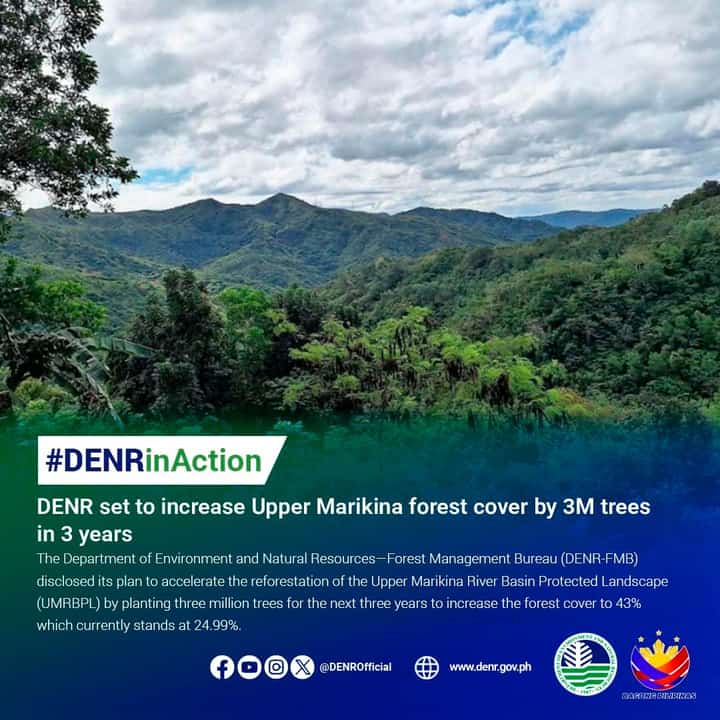
The Department of Environment and Natural Resources-Forest Management Bureau (DENR-FMB) announced Thursday a plan to accelerate reforestation of the Upper Marikina River Basin Protected Landscape (UMRBPL) by planting three million trees over the next three years.
This initiative aims to increase the area’s forest cover from its current 24.99 percent to 43 percent.
The UMRBPL was declared a protected area in September 2011 through Proclamation No. 296, two years after super typhoon “Ondoy” caused widespread devastation in lower Rizal Province, Marikina City and Metro Manila. The designation sought to conserve the area’s biodiversity, protect its watersheds, and ensure sustainable management of its natural resources.
The protected area spans 26,125.64 hectares across Antipolo City and the Rizal municipalities of Baras, Rodriguez, San Mateo and Tanay. It is home to threatened and endangered forest trees like Narra, red and white Lauan, Bagtikan, Kamagong and Molave, as well as wildlife including the Philippine Bulbul, black-naped Oriole, jungle fowl, Philippine deer, wild pig, Philippine monkey, monitor lizards and forest frogs.
It follows a 25 percent increase in closed forest cover reported a decade after the area’s establishment as a protected landscape.
FMB assistant director Atty. Ray Thomas Kabigting stressed the ecological significance of this increase in closed forests, which are denser and more biodiverse.
“The rise in closed forest cover signifies that previously degraded or barren areas are now thriving with healthy trees,” he said, attributing this success to sustainable forest management practices and reforestation efforts.