
Tzu Chi Eye Center treats kids with strabismus
The number of strabismus patients seeking free consultation and surgery at the Tzu Chi Eye Center increased last year to 22 from 19 in the previous year, indicating growing awareness on the facility.


Nearly blind or visually impaired adults and seniors usually pack the reception area of the Tzu Chi Eye Center in Sta. Mesa, Manila, but the medical facility run by the humanitarian organization Tzu Chi Medical Foundation Philippines also accommodates children patients.
On 24 January, six kids with special needs from Mariveles, Bataan and their guardians arrived at the center for their first-ever consultation with an ophthalmologist. They traveled for more than three hours aboard a vehicle provided by a philanthropist who referred them to Tzu Chi, according to the foundation.
Among the young patients was the one-year-old son of Mary Grace Oquialda, Warrior Sky, who had congenital anomalies including coloboma, a condition where a part of the eye doesn’t fully develop during pregnancy. At the Center, volunteer pediatric ophthalmologist Dr. Catherine Qui-Macaraig prescribed the boy with refractive eyeglasses and advised his mother to bring him to the Center for regular checkups to monitor his eye condition.
Another patient, 60-year-old Florenia Joseco’s grandson, Philip, had been showing signs of poor vision.
“He often stumbled when walking. His eyes also looked misaligned. At school, he had a hard time writing,” Florenia told the Foundation.
Dr. Qui-Macaraig also prescribed refractive eyeglasses to Philip, who also suffers from hydrocephalus, cleft lip and palate, and hernia, and told him to come back for checkups.
The Center’s volunteer eye doctors also perform surgeries on child patients to correct conditions like strabismus exotropia (banlag).
In 2023, 19 strabismus surgeries, five more than in 2022, were performed by the two volunteer pedia doctors of the Center, including Dr. Rica Abes Servera.
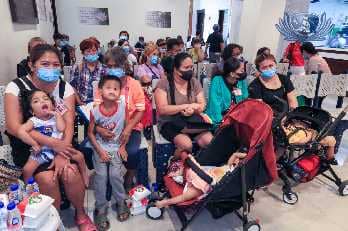
Group of young strabismus patients and their guardians (right) from Mariveles, Bataan wait for a check-up at the Tzu Chi Eye Center on 24 January.
Last year, there were 22 strabismus cases requiring operations, indicating that the number of children with strabismus seeking help from them is increasing.
Servera attributes the increasing number of young patients going to the Center to the increasing awareness on the facility.
The Center plays a crucial role in treating children with strabismus, which occurs in 2 to 5 kids per 100 people in the Philippines.
“We see more Exotropia (banlag) than Esotropia (duling),” says Servera.
According to Servera, most cases of strabismus would need surgery to correct. Surgery is done under general anesthesia so it usually cost around P100,000 to P150,000. Operating on more muscles will increase the cost since it would mean longer anesthesia time.
Among the successful surgery patient was a 20-year-old man who Servera recalled hugged her and cried during a post-surgery follow-up check-up because his exotropia was corrected.
“He said the surgery gave him the confidence to be better at his job and his personal life,” Servera recalls.
There was also a 60-something female with exotropia due to stroke.
“She suffered for years because of double vision, initially then later on. She learned to turn her face so she will only see one. She thought there was nothing to be done for her anymore. We did the first of the two surgeries that she would need,” Servera recalls.
“After the first surgery, her eyes are close to being centered. Her second surgery will help her widen her visual field,” she adds.
A child with exotropia was also successfully operated, according to Servera.
“Her mother cried the first time she saw her daughter look at her reflection in the mirror and said, ‘Mama, no one will bully me anymore.’”