
UN supports livelihood, housing for Surigao's vulnerable communities


Members of the L2R SDG Steering Committee convened last January 17, 2025 to discuss early gains and other possible courses of action in support of the joint programme. The committee consists of representatives from the government, implementing UN agencies, and members of vulnerable communities. Photo by UN Philippines.
A United Nations joint program launched in October 2024 is already yielding results, helping vulnerable communities in Surigao identify entrepreneurial opportunities to improve their living conditions.
The "Localize to Realize" (L2R SDG) program, implemented by UN Habitat and UN Women with funding from the Joint SDG Fund, focuses on supporting Sama Bajau and informal settler families. Proposed livelihood programs include aquaculture development, a materials recovery facility, and a neighborhood store with potential for e-commerce.
L2R SDG promotes a community-driven approach, allowing indigenous groups and informal settlers to engage in SDG-based planning and decision-making with local and national governments.
“Localizing the SDGs is about empowering communities to shape their own futures. By tailoring SDG initiatives to the unique cultural and socio-economic contexts of each community through involvement in decision-making, we pave the way for greater inclusion of vulnerable communities,” according to UN Philippines Resident Coordinator Gustavo Gonzalez.
Representatives from the Sama Bajau Council and informal settler associations are members of the L2R SDG steering committee and are an inherent part of decision making.
“Dako kaayo nig [tabang] sa amoa kay mavoice-out namo among gusto. Pasalamat kaayo mi na beneficiary mi sa mga balay ug naa pay SDG para sa among kabataan. (This is a big help for us because we can voice out what we want. We are thankful that we are beneficiaries of the housing project plus the SDGs which will benefit our youth),” said Sama Bajau Council member Ronald Bastiong.
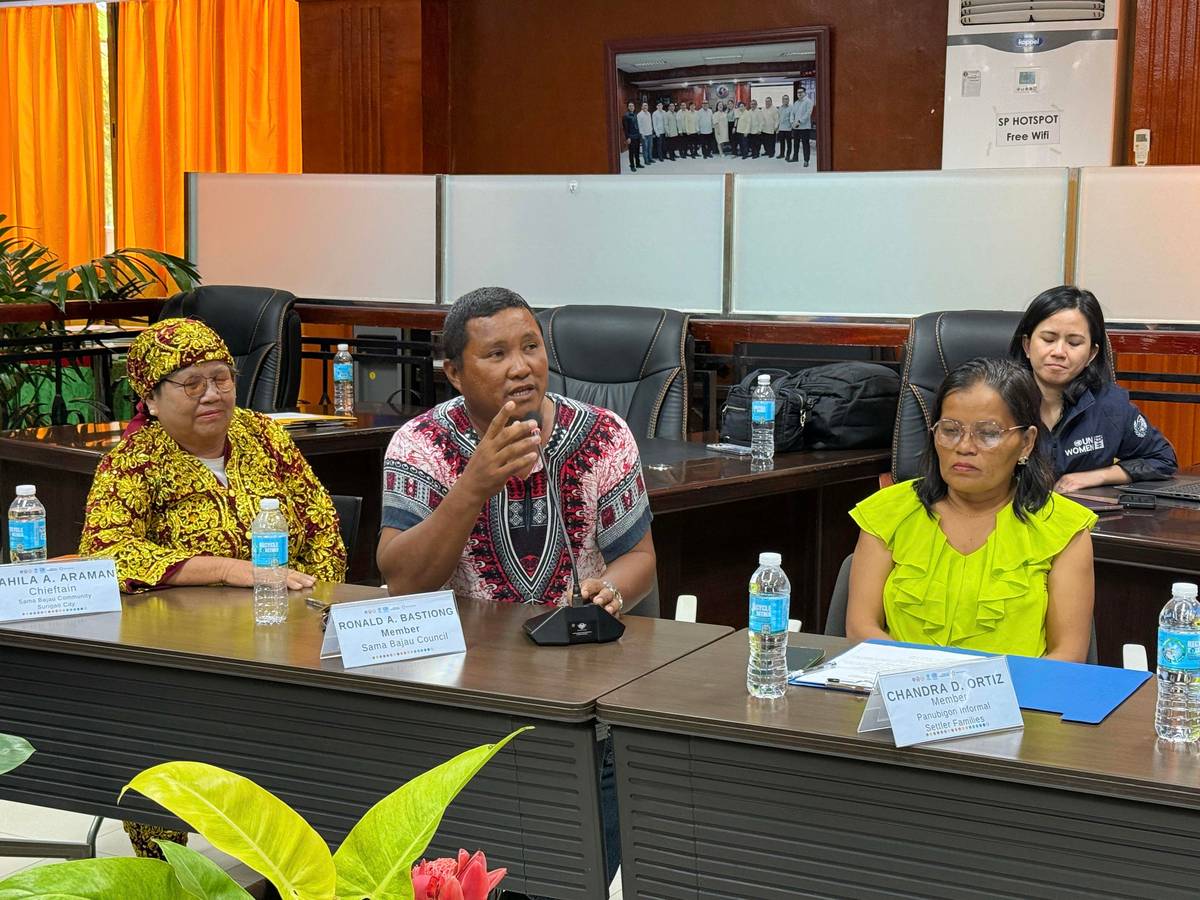
(L-R) Ms. Dahila Araman, Mr. Ronald Bastiong, and Ms. Chandra Ortiz from the Sama Bajau and informal settler communities in Surigao participate in the working group meetings of the L2R SDG joint programme together with key stakeholders from the local and national government, and participating UN agencies. Photo by UN Philippines.
They are also given a platform to provide inputs on how local initiatives can be aligned with their realities on the ground.
"The city government of Surigao wholeheartedly commits to support the initiatives that uplift marginalized communities - particularly the Sama Bajau who contribute so much to the culture fabric of our city," said Surigao City Mayor Pablo Yves Dumlao II.
Housing improvements
The Sama Bajau indigenous group is actively involved in the design and construction of culturally sensitive settlements under the Huy-anan nan Bajau sa Surigao (Home for Bajau in Surigao) Project implemented by UN Habitat and funded by the Spanish Government through the Spanish Agency for International Development Cooperation (AECID).
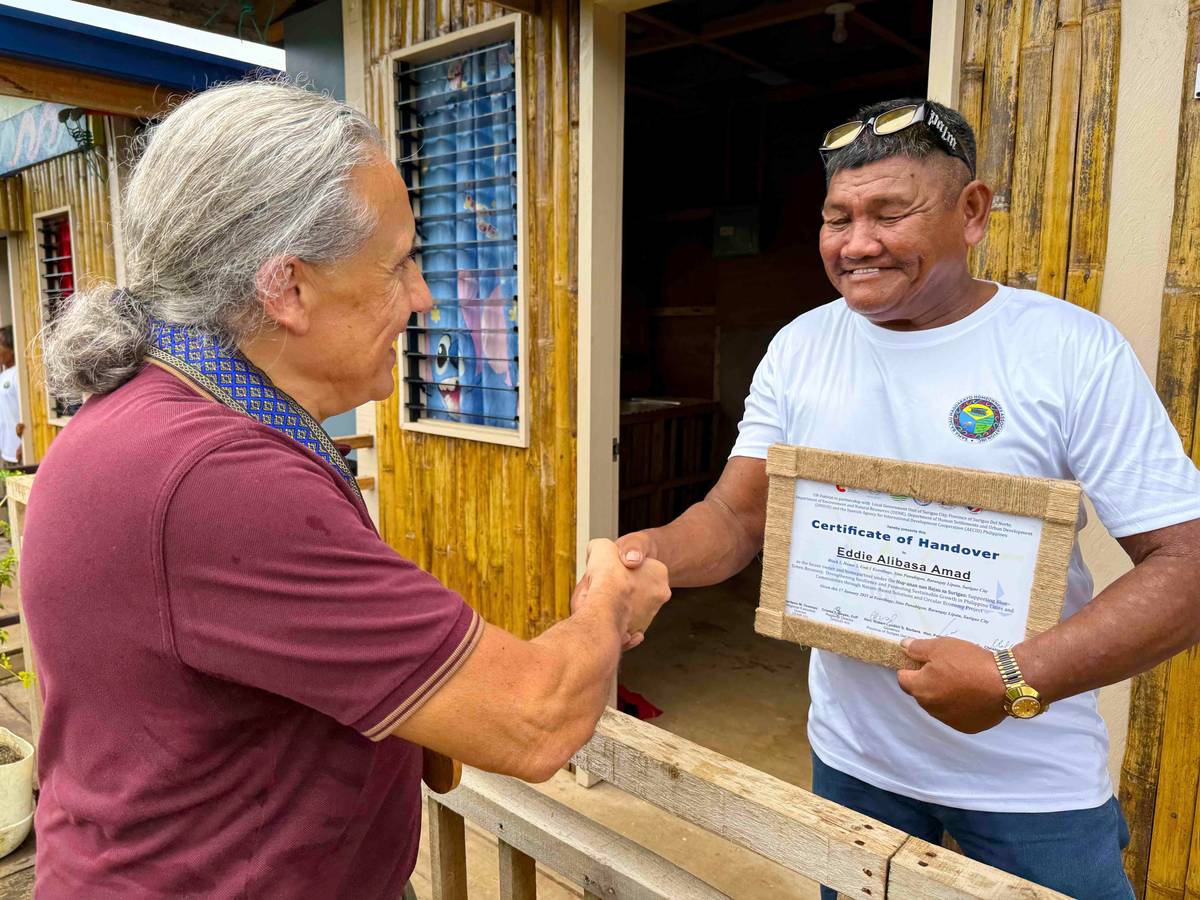
UN Philippines Resident Coordinator Gustavo Gonzalez shares a light moment with Mr. Eddie Alibasa Amad one of the recipients of housing units turned over under the Huy-anan nan sa Bajau sa Surigao Project. Photo by UN Philippines.
Through the project, Sama Bajau families will move to a resettlement area which is also being developed as an ecovillage by the Department of Environment and Natural Resources (DENR).
Currently, these groups reside in neighborhoods with no proper access to basic water and sanitation facilities.
As of this year, four housing units have been built - with one under construction. 20 units or five quadruplex stilt houses are targeted under the project.
“The desire and the wish of the Spanish Cooperation is to try to be with you [Sama Bajau] in the future to be possible to build double or triple of these houses. It is not only a house - it is a future, it is a better life,” according to Violeta Dominguez Acosta, Head of AECID Philippines.
Bringing SDGs to the families
A better understanding of development principles enables vulnerable communities to overcome stigma and help themselves. This is why the communities in the city received training on sustainable development goals and its impact on the lives of the communities organized by UN Women and UN Habitat.
This included a facilitated discussion on the rights of women, and children and highlighted the essential role of women-led households in improving living conditions. Trainers showed parents how to monitor the development of their children under a new scheme called Family Actions for Children and their Environs in Surigao (FACES). Over 80 families are participating in the programme.
“It is a privilege to work and be part of Localize to Realize project where we hope to see lived realities and vulnerabilities of women and IP communities surfaced and addressed with an SDG lens. We know that local women and IPs when informed, engaged, and empowered will not just be beneficiaries but key contributors to inclusive and sustainable development,” according to UN Women Philippines Country Coordinator Rosalyn Mesina.
The implementation of the L2R SDG joint programme and its complementing projects represent a significant step towards achieving the SDGs in Surigao City.