
MICT’s October TEU handling record-high
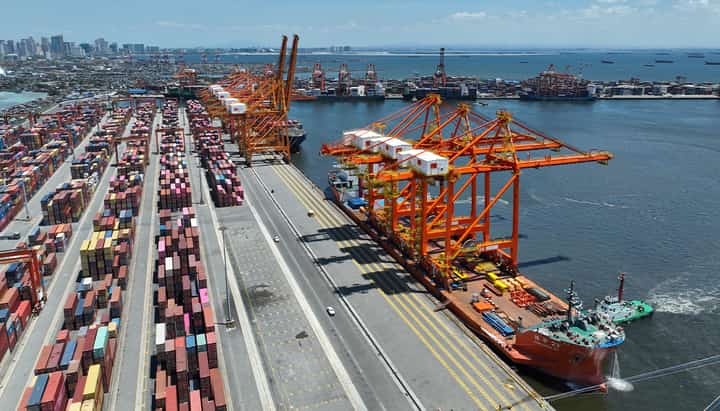
The Manila International Container Terminal (MICT), the country’s sole dedicated container handling facility, has achieved a milestone this year after receiving more than 275,000 twenty-foot equivalent units (TEUs) this October.
Aside from this, the Philippine Ports Authority (PPA) also made sure that they are prepared for the peak of cargo this holiday season.
The PPA, in a statement on Tuesday, said the MICT handled 275,028 TEUs last October, driven by recent growth in foreign trade, which includes an all-time high of 147,935 TEUs in imports.
Moreover, the PPA attributes the accomplishment to its partnership with International Container Terminal Services, Inc. (ICTSI) and the latter’s continued investments in infrastructure and equipment, which include replacing two old quay cranes at Berths 3 and 4 and increasing the number of quay cranes at Berth 6 from five to six.
Investing in larger, more advanced cranes to enhance the terminal’s ability to accommodate larger container vessels and meet the growing market demand.
“In addition, ICTSI is developing Berth 8, which is projected to boost MICT’s annual capacity to 3.5 million TEUs by 2027. “These upgrades ensure our terminals are ready to handle not only the seasonal surge but also the long-term trade growth,” said PPA General Manager Atty. Jay Daniel Santiago.
With this, Santiago extolled ICTSI for its proactive measures in managing seasonal demand.
Stable yard utilization
Meanwhile, the PPA said October’s yard utilization at MICT remained stable at 77 percent, with gross crane productivity averaging 26 moves per hour, highlighting the terminal's efficiency.
To prevent artificial congestion, the PPA enforces a three- to five-day dwell time for containers, promoting timely removal to maintain optimal flow.
Santiago emphasized, “Ports are designed to move goods efficiently—not serve as storage.”
He stressed that further reducing congestion risks the faster truck serving times at MICT, which result from infrastructure and technology improvements at the terminal gates.
“This, combined with coordination with local authorities of surrounding municipalities, helps streamline cargo movement in and out of the port, especially during high-demand periods,” he said.
The PPA further emphasized the role of public-private partnerships with major terminal operators in sustaining smooth operations.
ICTSI’s management of MICT, NorthPort Terminal, and Manila Multipurpose Terminal, alongside Asian Terminals, Inc. (ATI) at the South Harbor Terminal, has improved Manila’s port efficiency through automation, real-time tracking, and infrastructure upgrades.
“These advancements have also enhanced vessel productivity by enabling timely docking, unloading, and departure schedules. Santiago noted that this efficiency is particularly critical during the holiday season when cargo volumes surge,” he said.
With this, Santiago urged port users to schedule activities during off-peak hours to support uninterrupted operations throughout the busy season.
“With modern infrastructure and close collaboration among stakeholders, our port system is resilient and efficient, prepared to support the economy during the peak season and beyond,” he said.