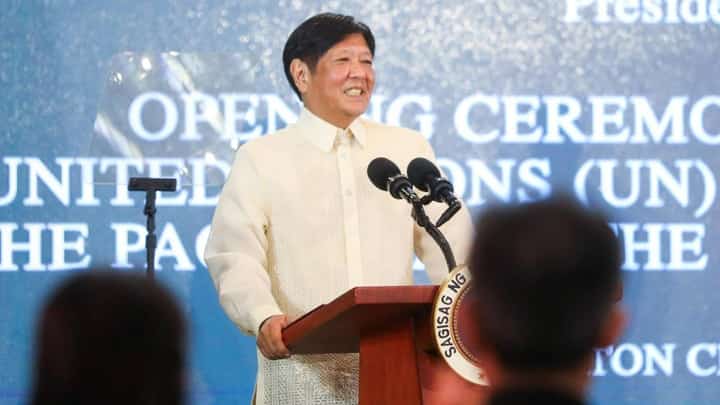
President Ferdinand Marcos Jr. said on Friday the government is working with the private sector to implement reforms that will enhance the tourist experience in the country as tourism plays a vital role in the Philippine economy.
The Chief Executive said this in his speech during the opening ceremony of the 36th Joint Meeting of the United Nations (UN) Tourism Commission for East Asia and the Pacific and the UN Tourism Commission for South Asia in Cebu City.
In his remarks, Marcos said there was a 48 percent increase in tourism's share of the gross domestic product (GDP) in 2023 compared to the previous year. The number translates to 8.6 percent of the total GDP, or roughly $35 billion.
Marcos also mentioned that the number of international tourist arrivals also surpassed targets, reaching 5.45 million in 2023 and 2.9 million in the first quarter of 2024.
Marcos said the government outperformed its 2023 tourist arrival target of 4.8 million after recording 5.45 million international tourists.
Beyond economic benefits, the President emphasized the positive impact tourism has on people's lives, both foreigners and tourists alike.
"These highlight the robust recovery and continued appeal of our country as a top travel destination. But going beyond monetary values and numbers, these figures also mean millions of lives being changed for the better," Marcos said.
"That's why I hope that our efforts here will lead to even better practices [and] more tourism arrivals not just for our country but for the entire world," Marcos added.
Hence, Marcos said both the government and the private sector are pursuing reforms encouraging tourists to “visit, stay, spend, and return" in the Philippines.
These reforms include easing visa access, enhancing water sanitation and healthcare facilities in tourist destinations, and improving connectivity hubs such as airports.
Marcos also wants the country to have a "greener" tourism sector that addresses climate change and ensures long-term industry health.
"I am of the belief that the greener you are, the better the tourism experience will be," Marcos stated.
"By adopting these practices, we create a tourism industry that not only creates responsible visitors but also uplifts the lives of those who are part of that activity," Marcos added.