
First-ever Sining Filipina art tilt empowers women creators


Photographs courtesy of BDO Unibank Inc., SM Supermalls, Zonta Club of Makati and Environs Foundation Inc. ‘Pira-pirasong Tela ng mga Marias’ by Hanna Joy Sayam, Figurative Category grand prize winner.
There's an old valued saying that goes, "You can kill a man, but you can't kill an idea." And guess what happened? Kindly read on.
A particularly innovative female-oriented proposal was voiced out by Joanne Zapanta-Andrada, vice president of Zonta Club of Makati and Environs Foundation Inc. (ZCME), in 2019. However, the dreaded Covid-19 pandemic brought the world into a standstill never seen before.
Inasmuch as nothing stays forever, while the country slowly regained its near normalcy, the ever-active club once again reviewed the project on hold, which aimed to recognize women, most specially in fields where men usually reigned.

So when Stella L. Cabalatungan, the executive vice president for BDO (Banco de Oro) Private Bank, learned from Tessie Sy Coson, BDO Unibank chairperson, of SM Group seriously considering an art-related event to celebrate National Women's Month, there was a "eureka" moment. Since Cabalatungan is presently the treasurer of ZCME, she eagerly hoped SM and BDO to be the main sponsors, which was graciously approved. The ball was officially put into motion, more than ready to roll.
And thus, Sining Filipina National Art Competition, the first of its kind, was born. It proudly carries a thrust: "The world needs to see the world in the eyes of a woman. The country needs to see itself in the eyes of its women." To further explore this advocacy, the tilt sought to encourage, nurture and promote the Filipina as a vehicle for women empowerment in her role as an artist.
"We wanted to provide opportunities to all Filipina artists, regardless of age, the chance to express their creative talents and be recognized. So many women have the artistic skills but do not have the means nor connections to showcase their works. What we wish to bring to all of them was hope. The hope that there is a venue for them for people to appreciate their works and be discovered," Cabalatungan elaborated.


To simplify the guidelines, only pieces in acrylic, oil and watercolor were accepted. The canvas size was likewise limited to certain measurements. All submitted artworks needed to adhere to the theme of woman power.
"We opened this to all ages, professionals and non- professionals alike, from all over the country so that we could provide a level playing field for everyone. We believe that just like education, art could be a great equalizer. We just had to open the doors to break the glass ceiling for them," Cabalatungan further explained.


Zapanta-Andrada was initially woeful of the expected turnout. "We were given only three weeks between the press launch in January and the first round of judging. I had serious doubts as to whether we would be receiving a lot of entries. The window of time was too short!" she said.
However, Cabalatungan encouraged with "Never underestimate the will of women artists! The entries will be pouring in albeit at the last minute!"
The obras came pouring in, one after another, sometimes in a drizzle, but more often in a storm.
The tourney was a huge success in terms of diversity with approximately 85 percent of entrants from outside of Metro Manila, including Ilocos Region, Benguet, Negros Island, Bohol, Cebu, Davao, Misamis Oriental and Cotabato City.
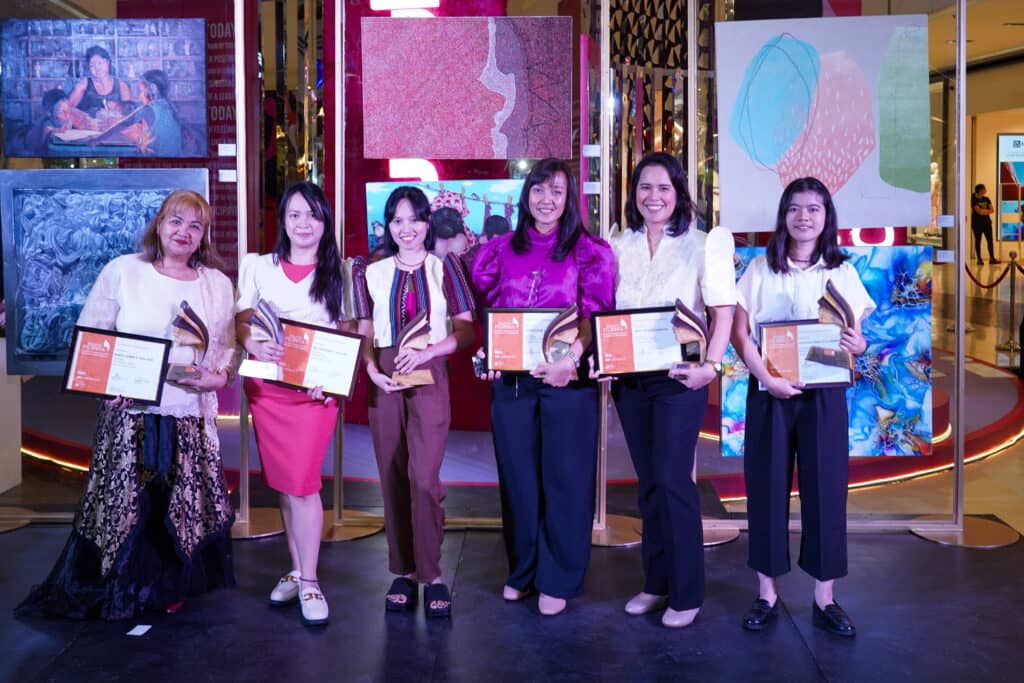
For the Figurative Category, first place was awarded to Hanna Joy Sayam from Negros Occidental for her Pira-pirasong Tela ng mga Marias. Luckyshia Jenielou Canonigo for Gabay na Ilaw placed second, while Ma. Christina Baltero for Kula got third.

For Sayam, her motivation came from experiences for being judged due to her simple preferences. "Whether it's my liking for floral patterns, the color pink or vibrant hues, society tends to perceive these choices as indicators of weakness, especially when they come from women. Criticism often originates from men, leading me to ponder the implications of being judged solely based on such preferences," she lamented.
"This reflection evokes gratitude towards our ancestors who navigated similar judgments. Thanks to their resilience, we now enjoy a vast array of choices, despite lingering biases. Their struggles far outweigh the minor biases we encounter today," she explained in gratitude.

"I prefer not to compare my creations with those of others. My primary focus is on how my work communicates a message to everyone who views it. If my art moves them in some way, it's up to the viewers to decide if they find my work unique compared to what they have seen before," she ended.
For the Non-figurative Category, Maria Gemma San Jose from Ilocos Norte took home the top laurel for Layers of Experience. Maria Melissa Sangoyo was hailed as second for her She's Not That Complicated, while Isabelita Rodillo clinched third for The Power of Many.
San Jose grieves the loss of her very first visual arts teacher, her own father. "Doing art on a deadline, in my most sorrowful days, helped ease the pain," she recalled.
She was set apart from the competition due to her unique tool — barbeque sticks as vehicles for her pointillism strokes. "It's a slow process, one dot at a time, with at least seven layers to fill the white space of the canvas. It's never easy, but I immensely enjoyed because it relaxed me and gave me time for introspection. But the final output is not just for myself — it's for spectators to enjoy. They even wonder, for I hear feedbacks of inspiration," she related.
The artworks were judged by an esteemed panel of judges, whose identities were kept under wraps until the awarding ceremony. The lineup included Julie Lluch, internationally renowned multi-awarded sculptor and a master of clay and terracotta; and Mark Justiniani, a painter known for his socio-politically fueled works. They were joined by Kenneth Esguerra, senior curator and head of Conservation of the Ayala Museum; Tina Colayco, the Metropolitan Museum of Manila president and professor and former dean of the University of the Philippines (UP) College of Fine Arts; and Victoria T. Herrera, Ateneo Art Gallery director and chief curator, former Cultural Center of the Philippines (CCP) Visual Arts and Museum Division director, and UP Baguio's Museo Kordilyera curatorial consultant.
Grand prize winners received P250,000 each, while second and third placers received P150,000 and P100,000, respectively.