
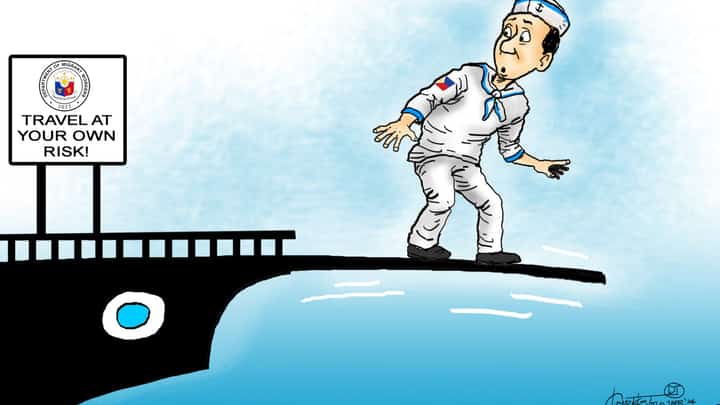
Tightrope or gangplank?
The impact of the Philippines’ policy adjustment could prove enormous, while empowering Filipino sailors may also result in crew shortages for shipping corporations.
The Philippines provides 25 percent of the global seafaring workforce, with the sector serving as a linchpin of the national economy. In the month just ended, the country took a bold step to safeguard its vast maritime labor pool in response to a string of deadly attacks by Houthi rebels in the Red Sea and Gulf of Aden.
As promised, the Department of Migrant Workers (DMW) has implemented the “right to refuse sailing” policy for Filipino seafarers on high-risk routes that are not limited to the areas previously mentioned.
The decisive action — following the tragic deaths of two Filipino seamen in a recent missile strike on the M/V True Confidence and the kidnapping of 17 others from the ship Galaxy Leader last November — stands in stark contrast to the approaches taken by some other countries.
For example, while India offers financial incentives to its seafarers braving dangerous waters, the Philippine government prioritizes their immediate safety and empowerment when choosing their deployment. This policy shift was outlined in a recent order by DMW officer-in-charge Undersecretary Hans Leo Cacdac.
The directive requires local manning agencies to provide seafarers with a comprehensive explanation of the risks involved in sailing the Red Sea and Gulf of Aden. This includes making Anti-Piracy Awareness Training for Seafarers mandatory, an essential step given the Houthi rebel activities roiling the area.
Likewise, agencies must also notify seafarers of any planned trips through these war-like zones (WLZs) and high-risk areas (HRAs), clearly stating their rights and benefits should they decide to decline the trip or continue. Perhaps most importantly, the decree ensures the timely and safe return of seafarers who use their right to refuse sailing on certain perilous routes.
The DMW has also taken steps to prevent discrimination against seafarers who use this freedom, ensuring that it does not harm their current or future employment opportunities. Furthermore, to formalize a seafarer’s refusal, local manning agencies must produce a “Confirmation of Refusal to Traverse” paperwork.
Prior to his order, Cacdac backed the International Bargaining Forum’s (IBF) earlier decision to declare the southern Red Sea and Gulf of Aden a “war-like zone” for sailors. This designation, as stipulated in the 2006 Maritime Labor Convention (MLC), acknowledges the high dangers experienced by seafarers operating in this region, comparable to those encountered during armed conflict.
The “war-like zone” designation also opens the door to stricter safety measures, such as route diversions to avoid these areas, enhanced security training for crews on emergency protocols, and the provision of vessels with additional security measures such as citadels, personal protective equipment, and even armed personnel on board. Contingency strategies for violent occurrences are also expected to be discussed.
The impact of the Philippines’ policy adjustment could prove enormous, while empowering Filipino sailors may also result in crew shortages for shipping corporations. This, in turn, may drive employers to bypass Filipino workers entirely in favor of those from countries without similar refusal rights.
The Philippines has one of the world’s biggest pools of professional seafarers, and jeopardizing their employment would be a major blow to the national economy. With these two opposing considerations, the Philippine government is walking a tightrope.
Protecting its seafarers is critical for the Philippines, but the same holds true regarding maintaining the continuous employment of its enormous pool of competent mariners.
The “right to refuse sailing” policy empowers Filipino workers while putting the responsibility on maritime corporations to prioritize crew safety. This could encourage corporations to implement stricter safety measures, thereby decreasing the danger for Filipino sailors.
Still, whether this approach would be successful or not depends on thorough implementation and transparent communication among manning agencies, sailors, and shipping firms. Without safeguards in place, the policy could backfire, preventing seafarers from exercising their right to reject trips for fear of jeopardizing their careers.
The following months will surely indicate whether this policy can achieve its goals while maintaining the Philippines’ position as a top provider of experienced mariners to the world or whether it will result in Filipino sailors walking the gangplank to perdition.