




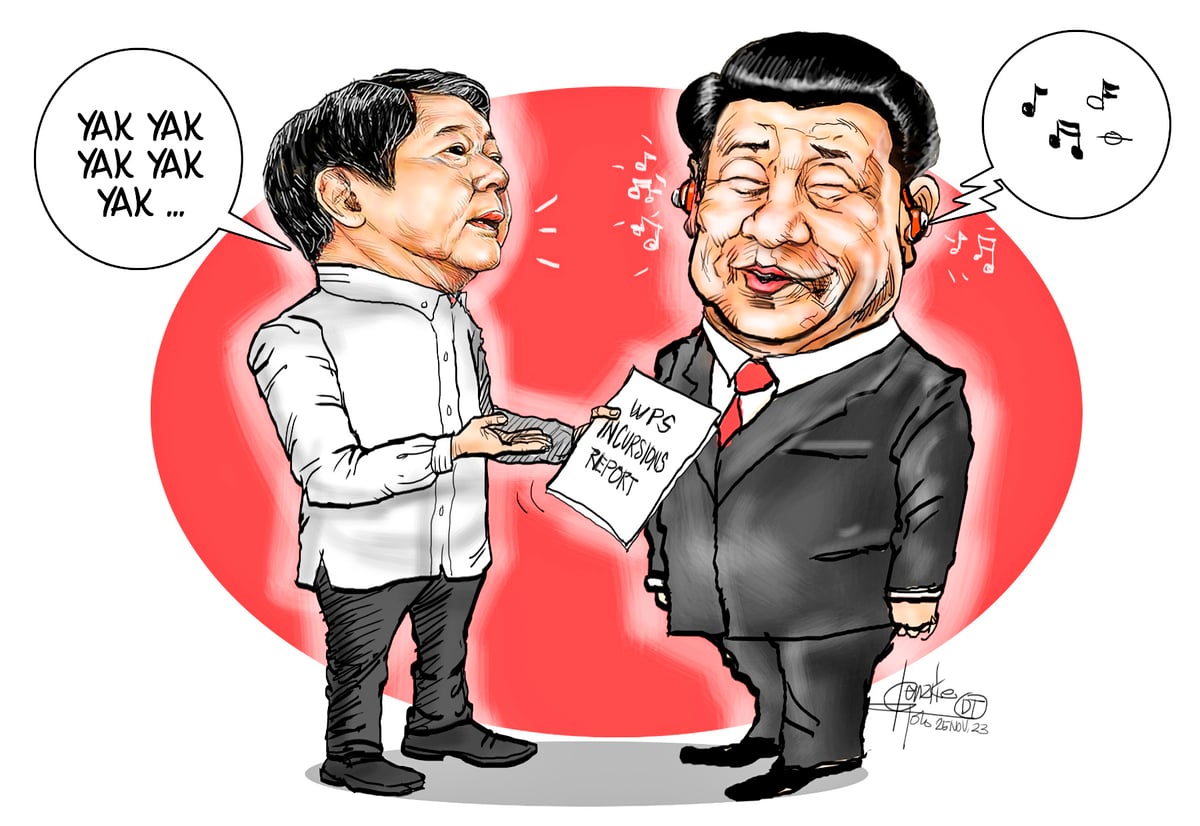
BBM, Xi meeting useless exercise
No one, not the President, is saying anything about the matter.
Text size
No one, not the President, is saying anything about the matter.
How did the exchange between President Ferdinand R. Marcos Jr. and the paramount leader of China, Xi Jinping, go when they met behind closed doors on the sidelines of the APEC meeting in San Francisco last week?
The President said he would meet with Xi and bring up incidents of harassment of Philippine seacrafts by Chinese Coast Guard and maritime militia in Philippine waters (which, of course, is disputed by the Chinese), as well as discuss ways by which tensions could be reduced in the South China Sea, including granting unhampered access to their usual fishing grounds to Filipino fishermen.
"We tried to come up with mechanisms to lower tensions in the South China Sea," the President told the media after the meeting with the Chinese leader, adding that he, "asked that we go back to the situation where both Chinese and Filipino fishermen were fishing together in those waters.
What "mechanisms" were discussed, if indeed, they were taken up by Messrs. Marcos and Xi?
And how did Xi respond, or react, to the President's expressed concerns? No one, not the President, is saying anything about the matter, but after he met with Xi, he flew to Hawaii, where he and AFP Chief of Staff Gen. Romeo Brawner Jr. were hosted by USINDOPACOM Commander, Admiral John C. Aquilino.
The USINDOPACOM's area of responsibility encompasses about half of the earth's surface, stretching from the waters off the US West Coast to India's western border and from Antarctica to the North Pole.
Command personnel include some 400,000 soldiers, sailors, Marines, airmen, Coast Guardsmen, and Defense Department civilians responsible for all US military activities in the Indo-Pacific region, which covers 36 nations, 14 time zones, and over 50 percent of the world's population.
Marcos' hosted visit to the USINDOPACOM was described as "rare" for a head of state. Also, he was the first Philippine chief of state to be invited inside the base.
In the briefing given to him by Admiral Aquilino, the President was shown a model of a base being built in the West Philippine Sea by China's People's Liberation Army, an indication of Chinese construction activity getting "closer and closer to us, the nearest now being 60 nautical miles from the nearest Philippine coastline, and this is an evolving situation," the President said at the Asia-Pacific Center for Security Studies-organized Daniel K. Inouye Speaker Series in Oahu which he attended after his USINDOPACOM visit.
President Marcos' statements at the forum in Oahu indicated that his earlier meeting with President Xi in San Francisco was virtually all for naught.
He expressed concern that tensions between the Philippines and China in the South China Sea continue unabated, with "persistent unlawful threats being made against Philippine sovereign rights and jurisdiction over our exclusive economic zone."
His frustration was apparent as he said, "We are still waiting for a code of conduct (in the South China Sea) between China and the ASEAN, and progress has been slow, unfortunately."
He then revealed that he had taken the initiative to approach co-ASEAN member countries with whom the Philippines has existing territorial conflicts, including Vietnam and Malaysia, to craft "our own code of conduct. Increasing tensions in the South China Sea requires that we partner with allies and friends around the world so as to come to some kind of resolution and maintain peace."
Back in Manila last Monday, the President announced the start of the three-day joint Philippine-US maritime and air patrols in the West Philippine Sea (including the Luzon Sea and the waters around, within, and adjacent to the Kalayaan Island Group and Bajo de Masinloc), aimed at enhancing the capacity of both military forces' equipment to operate in conjunction with each other in patrolling the area.
These developments have stirred up China, which has accused the Philippines of mobilizing "foreign forces" to patrol the SCS and "stirring up trouble and engaging in hype, undermining regional peace and stability.
The Chinese Ministry of Foreign Affairs has also taken issue with President Marcos' attempt to engage ASEAN neighbors to come up with a code of conduct separate from the non-binding Declaration on the Conduct of Parties in the South China Sea (DoC) inked by China and ASEAN in Cambodia in 2002.
Since 2002, China has been saying it agrees to inking a Code of Conduct in the SCS through the DoC at "the appropriate time" and/or when the time is ripe.
When will things be "ripe" enough for China — when it is done with its island-building activities, creating air and naval bases that it will use to control the SCS for its purposes?
Housing is probably the biggest issue affecting people the world over.
Malacañang on Monday called for a more thorough investigation into the questioned flood control projects in Taguig…
The defense on Monday backed the move by senator-judges to exclude a prosecution witness who testified on the firearms…
