 Daily Tribune
China’s relentless bullying tactics in the WPS have pushed the Philippines to the brink of a serious diplomatic action — the recall of its ambassador.
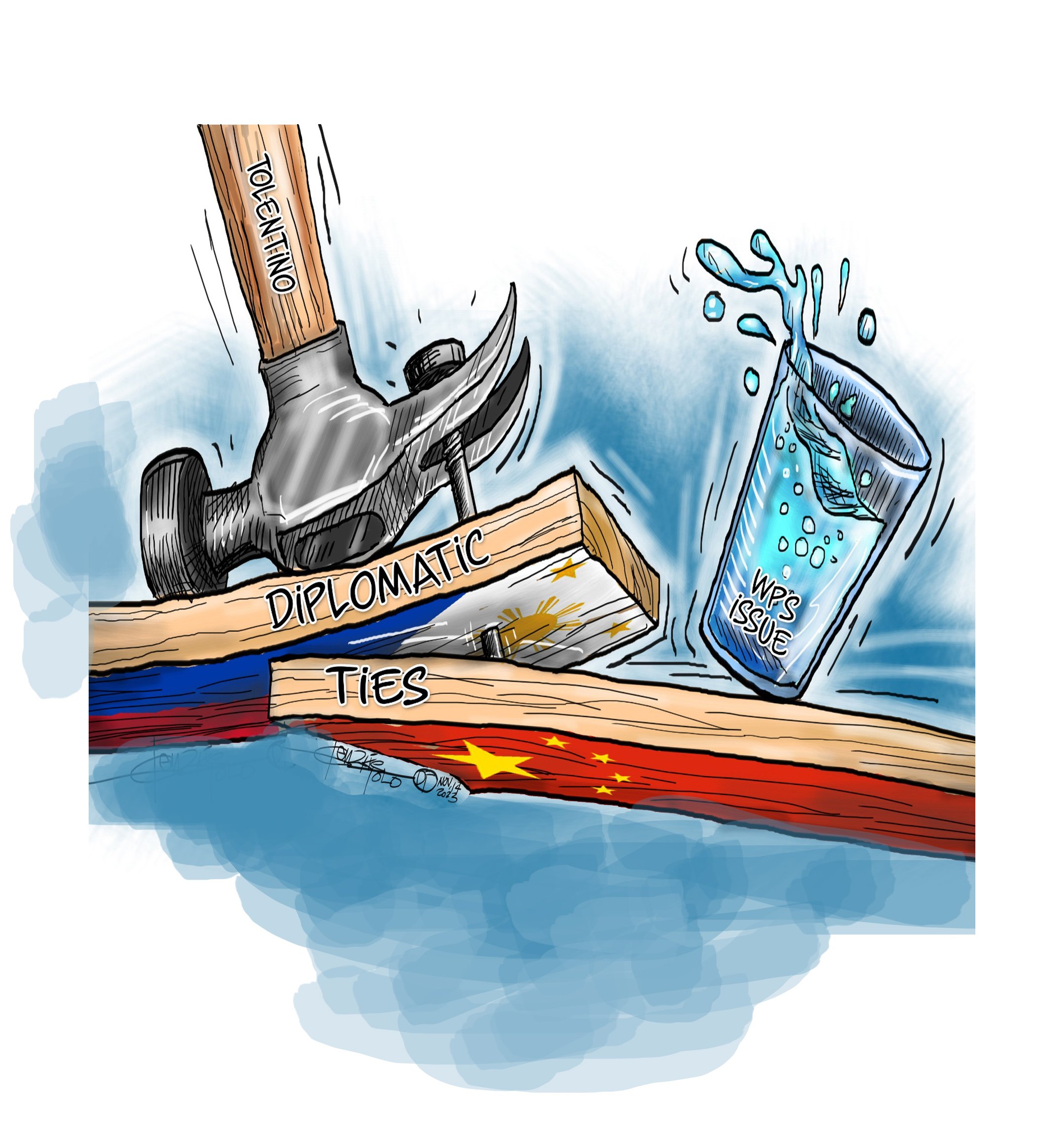
Two major dailies on Monday, one being DAILY TRIBUNE, bannered a proposal made by Senator Francis Tolentino for the Philippine government to consider recalling its envoy to Beijing, Ambassador Jaime Florcruz, to express the country's displeasure over China's latest actions in the West Philippine Sea.
By recalling Florcruz, even if just "temporarily," Tolentino said Manila would be sending a very strong message to China that its latest harassment of the Philippine resupply mission to its troops aboard the BRP Sierra Madre at Ayungin Shoal is condemnable.
When Tolentino said China "disrespected" the Philippines, he was referring to the actions of at least 11 Chinese vessels that had not only tried to block five Philippine boats but had also trained a water cannon on one last 10 November.
It was only the second time that the China Coast Guard had used a water cannon, but it was the nth time its vessels had conducted dangerous actions against much smaller boats within the Philippines' 200-nautical mile exclusive economic zone.
Its territorial claim to the WPS affirmed in 2016 by the Permanent Court of Arbitration based in The Hague, the Philippines has every right to keep the Sierra Madre and the troops on it at Ayungin Shoal, as well to resupply them with provisions while undertaking personnel rotations.
Ayungin is way closer to the Philippines than to China, thus there's no doubt on which side of the ocean the WPS is located. To belabor China's illegal actions in the WPS, its own all-encompassing claim in the South China Sea had been shot down by the same arbitral court.
Insofar as China's actions in the South China Sea — which overlaps the WPS — are concerned, they are anchored on the bully's mentality that might makes right. That being the case, Tolentino's proposal would certainly be welcomed by many Filipinos.
But not so fast.
Recalling an ambassador, in diplomacy, should never be a knee-jerk reaction, as it is a formal act of a sovereign nation to withdraw its highest-ranking representative from another country. It is a serious diplomatic step that is typically taken to express strong disapproval of the host country's actions or policies.
Recalling envoys dates back to ancient times as when the Greek city-states recalled their ambassadors when they were displeased by the actions of the other, like when the Spartans felt subordinated by the intellectual snobs who were the Athenians.
While the Vienna Convention on Diplomatic Relations adopted in 1961 made no mention of the act of recalling ambassadors, it has an inverse provision whereby a receiving state may declare a diplomat "persona non grata."
A diplomat declared persona non grata means he or she is no longer welcome in the receiving country and must leave. If the declaration is on account of a personal misdeed, a replacement may just be appointed, but when the declaration is to show displeasure at the sending country itself, then the act takes on a far more serious undertone.
Both the recall of an ambassador and a declaration of one as persona non grata can deteriorate into a tit for tat by both countries choosing to call home their envoys and severing diplomatic relations.
Recalling an ambassador can have very serious consequences, including a significant deterioration in relations between two countries, making it difficult for the two to cooperate even on issues of mutual interest. There could be a decline in trade and investment between the two countries, as businesses may be less willing to invest in a country with a strained relationship with its key partners.
China's relentless bullying tactics in the WPS have pushed the Philippines to the brink of a serious diplomatic action — the recall of its ambassador — as it can no longer tolerate Beijing's blatant disregard of international law and Philippine sovereignty.
Still, the Philippines must not be led to actions, like the powerful symbolic recall of its ambassador, that could further heighten tensions in the WPS and sour some more the relations between Manila and Beijing.
Let's leave diplomacy to the diplomats.


