 Daily Tribune
Teodoro said the Chinese ships ‘intentionally’ hit the Philippine vessels trying to resupply the troops stationed on the BRP Sierra Madre.
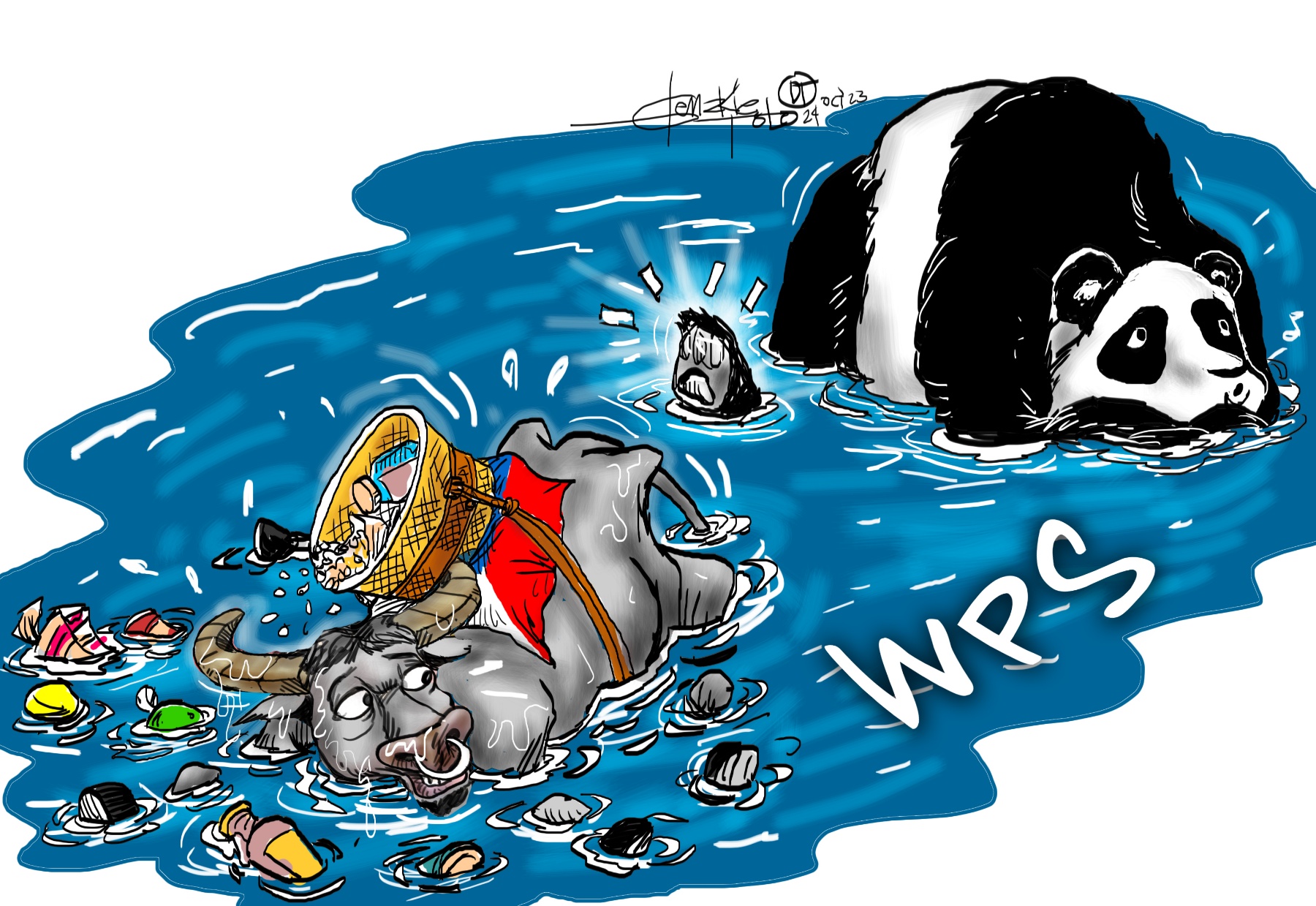
In a prior editorial, this paper raised the possibility that the Chinese vessels hitting a Philippine Coast Guard ship and a resupply boat it was escorting to Ayungin Shoal in the West Philippine Sea might have been intentional.
While we let readers read between the lines, factual narrations of the event tended to show how improbable it would have been for two separate collision incidents, involving several Chinese and Philippine vessels, to happen by accident in the wide expanse of ocean.
The two collisions happened miles away from each other amid fair weather conditions with the sun shining brightly, thus neither poor visibility nor questionable seamanship could have been a factor in the incidents.
As in most cases, the simplest explanations often prove to be the correct or accurate ones. In these incidents, the latest in China's aggressive maneuvers in the WPS, the actions taken by the Chinese coast guard and militia vessels smacked of premeditation.
On Monday, Defense Secretary Gilbert Teodoro confirmed in a press briefing that the Chinese vessels "intentionally" hit the Philippine boats trying to resupply troops stationed on the intentionally grounded navy vessel, the BRP Sierra Madre.
"While conducting legitimate rotation and resupply operations within the exclusive economic zone of the Philippines, Chinese coast guard and maritime militia vessels, in blatant violation of international law, harassed and intentionally hit the Unaiza May 2 and Philippine Coast Guard vessel BRP Cabra," Teodoro said.
It was a conclusion that would not have required the title Defense Secretary to make. Video footage and photos of the first incident showed a China Coast Guard ship chasing the very small resupply boat. As if the David-versus-Goliath affair were not enough, a second CCG vessel then cut off the boat.
All the pieces of evidence considered, the word "collision" does not apply to the actions China took because this would presuppose the possibility of their being mere accidents. The operative word should be "bumped" or, if the incident resulted in grave damage to the Philippine vessels, "rammed."
The stern of the smaller resupply vessel and the bow of the Chinese coast guard ship were seen briefly touching in the video released by the Philippine military.
According to a statement from the National Security Council, the supply boat sustained damage. It added that a second resupply boat was able to complete its mission to the BRP Sierra Madre.
With the United States and Canada condemning China over the incident, the collision may not be the last or it may just be a portent of more serious "interactions" to come between China and the Philippines as both assert their respective sovereign claims in the WPS.
If only to ensure peace in the Indo-Pacific region, countries that have pledged to conduct freedom of navigation patrols in the South China Sea should start doing so.
The burden of checking Beijing's expansionist designs in the region should be shared not only by other claimant nations, but by governments that benefit from the trillions of dollars in trade that pass annually through the South China Sea.
We cannot expect the Philippines' summoning of the Chinese ambassador over the incidents to amount to anything, except to register the country's strong and continuing opposition to Beijing's aggressive acts in the WPS.
China can never claim Ayungin to be part of its sovereign waters because it lies 1,000 kilometers from its nearest major landmass, Hainan Island, while the shoal is only 200 kilometers from the western Philippine island of Palawan.
This proximity of Ayungin Shoal to Palawan, along with other proof presented by the Philippines to the Permanent Court of Arbitration in The Hague, was primarily considered by the court in ruling in favor of the Philippines in 2016.
China had refused to recognize the arbitral ruling precisely because it did not go its way. In fact, the court declared as baseless China's nine-dash line claim to nearly the entire South China Sea.
CCG's ramming of Philippine vessels is a calculated act of provocation. It is a message to the Philippines and the rest of the world that China is willing to use force to achieve its goals. Beijing's actions are a threat to peace and stability in the South China Sea and the Asia-Pacific region. Nations must not allow China to succeed in its bullying tactics.
The international community must take a stand and not allow China to undermine the rules-based order in the Asia-Pacific. The aggression being shown by Chinese maritime assets is a threat to the world, and must be stopped.


